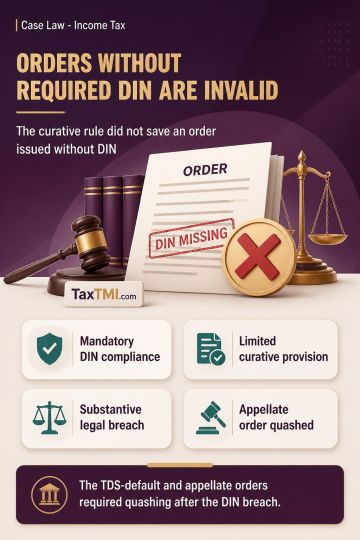
Document Identification Number compliance renders TDS-default orders invalid where mandatory DIN requirements are breached and curative provision does...
The Indian Finance Minister's upcoming FY2025-26 Budget presentation focuses on critical fiscal metrics and consolidation targets. The government aims to reduce fiscal deficit to 4.5% of GDP, continuing from the current year's 4.9% target. Capital expenditure is projected at Rs 11.1 lakh crore, though actual spending may be lower due to electoral delays. The Budget addresses debt management with a target to reduce general government debt-to-GDP ratio from 85% to 60%. Key revenue projections include gross tax revenue of Rs 38.40 lakh crore, with Rs 22.07 lakh crore from direct taxes and Rs 16.33 lakh crore from indirect taxes. GST collections are anticipated at Rs 10.62 lakh crore, while nominal GDP growth is estimated at 10.5%.
The Indian Finance Minister's upcoming FY2025-26 Budget presentation focuses on critical fiscal metrics and consolidation targets. The government aims to reduce fiscal deficit to 4.5% of GDP, continuing from the current year's 4.9% target. Capital expenditure is projected at Rs 11.1 lakh crore, though actual spending may be lower due to electoral delays. The Budget addresses debt management with a target to reduce general government debt-to-GDP ratio from 85% to 60%. Key revenue projections include gross tax revenue of Rs 38.40 lakh crore, with Rs 22.07 lakh crore from direct taxes and Rs 16.33 lakh crore from indirect taxes. GST collections are anticipated at Rs 10.62 lakh crore, while nominal GDP growth is estimated at 10.5%.
Note: It is a system-generated summary and is for quick reference only.
 TaxTMI
  TaxTMI
 of 4918