Mutual fund maturity rules require proper rollover, redemption, disclosure, and due diligence; investor gains cannot excuse regulatory breaches or pen...
Threshold exemption excludes exempt services, while stamp-paper purchases avoid reverse charge; consequential service tax penalties were also set asid...
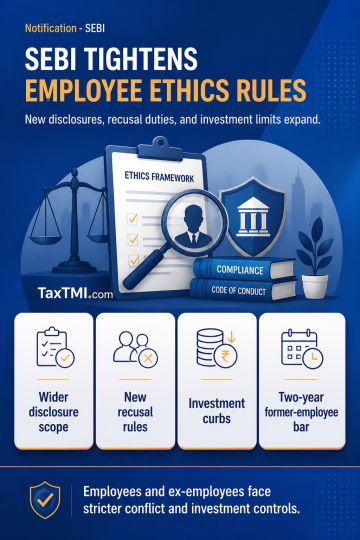
Employee conflict disclosures and investment restrictions expand with new recusal duties, post-employment limits, and compliance reporting requirement...
HC ruled that principles of res judicata apply to subsequent applications u/s 466 of Companies Act, 1956. The Court dissolved the stay on winding-up proceedings, emphasizing that mere settlement with creditors or workers is insufficient grounds for staying liquidation. The discretionary power u/s 466(1) requires proof satisfying the Court that proceedings ought to be stayed. The Court must consider commercial morality beyond creditors' wishes. The jurisdiction to stay proceedings can only be exercised to revive the company or its business, not to facilitate acquisition of assets at undervalued prices. The appeal was allowed, setting aside previous orders for failing to properly apply Section 466 principles and consider vital evidence.
HC ruled that principles of res judicata apply to subsequent applications u/s 466 of Companies Act, 1956. The Court dissolved the stay on winding-up proceedings, emphasizing that mere settlement with creditors or workers is insufficient grounds for staying liquidation. The discretionary power u/s 466(1) requires proof satisfying the Court that proceedings ought to be stayed. The Court must consider commercial morality beyond creditors' wishes. The jurisdiction to stay proceedings can only be exercised to revive the company or its business, not to facilitate acquisition of assets at undervalued prices. The appeal was allowed, setting aside previous orders for failing to properly apply Section 466 principles and consider vital evidence.
Note: It is a system-generated summary and is for quick reference only.
 TaxTMI
 of 4805













 Join Channel


 TaxTMI