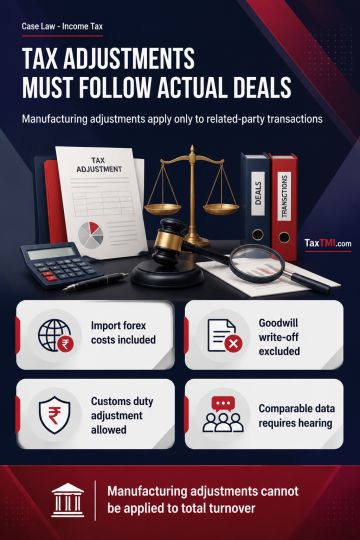
International transaction benchmarking restricts transfer pricing adjustments to associated-enterprise dealings, while functional comparability govern...
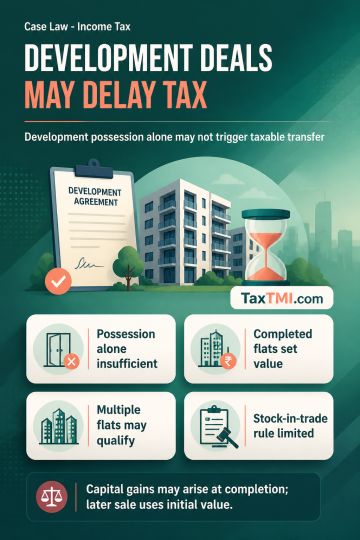
Joint development agreements defer taxable transfer where possession lacks part performance, while completed flats determine consideration and exempti...
Passenger baggage re-export requires true declaration and cannot be granted indirectly through discretionary redemption of undeclared prohibited goods...
HC ruled that principles of res judicata apply to subsequent applications u/s 466 of Companies Act, 1956. The Court dissolved the stay on winding-up proceedings, emphasizing that mere settlement with creditors or workers is insufficient grounds for staying liquidation. The discretionary power u/s 466(1) requires proof satisfying the Court that proceedings ought to be stayed. The Court must consider commercial morality beyond creditors' wishes. The jurisdiction to stay proceedings can only be exercised to revive the company or its business, not to facilitate acquisition of assets at undervalued prices. The appeal was allowed, setting aside previous orders for failing to properly apply Section 466 principles and consider vital evidence.
HC ruled that principles of res judicata apply to subsequent applications u/s 466 of Companies Act, 1956. The Court dissolved the stay on winding-up proceedings, emphasizing that mere settlement with creditors or workers is insufficient grounds for staying liquidation. The discretionary power u/s 466(1) requires proof satisfying the Court that proceedings ought to be stayed. The Court must consider commercial morality beyond creditors' wishes. The jurisdiction to stay proceedings can only be exercised to revive the company or its business, not to facilitate acquisition of assets at undervalued prices. The appeal was allowed, setting aside previous orders for failing to properly apply Section 466 principles and consider vital evidence.
Note: It is a system-generated summary and is for quick reference only.
 TaxTMI
 of 4798












 Join Channel


 TaxTMI
