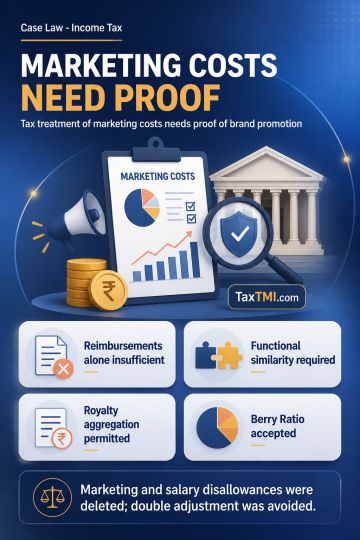
Transfer pricing requires evidence for AMP transactions, functionally reliable comparables, and appropriate aggregation or Berry Ratio benchmarking me...
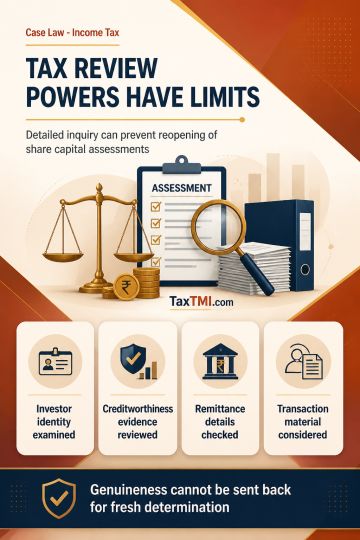
Revisionary jurisdiction cannot reopen share capital assessments where adequate inquiry supports a permissible view and no independent error is establ...
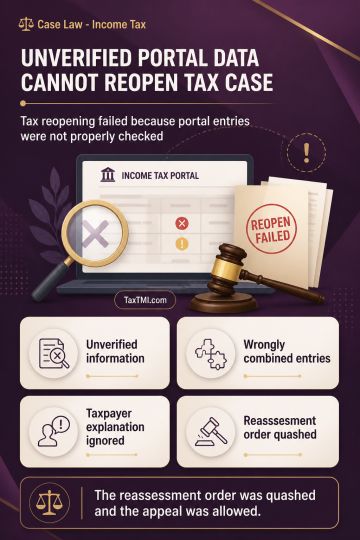
Reassessment jurisdiction fails where unverified portal information is aggregated without examining the taxpayer's explanation or relevance of entries...
Statutory sanction for delayed reassessment requires approval from the prescribed authority; approval by an inferior authority invalidates jurisdictio...
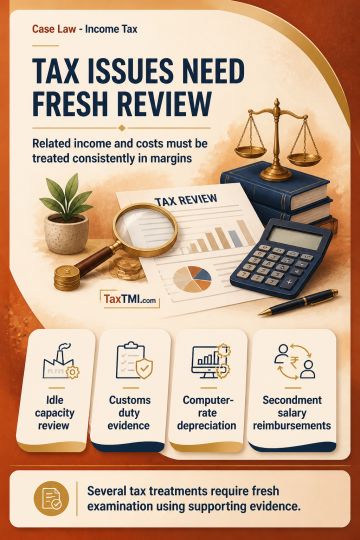
Transfer pricing margin adjustments require matching treatment of non-operating income and related costs, with comparability issues reconsidered on ev...
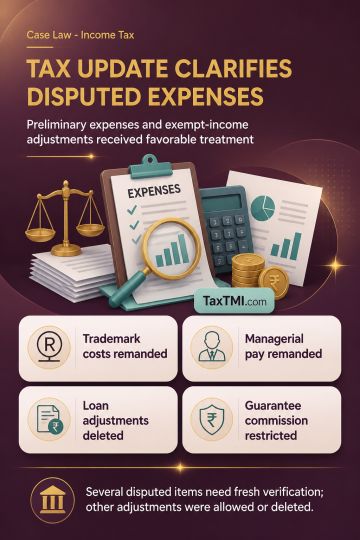
Preliminary-expense amortisation and MAT exempt-income adjustments prevailed, while trademark costs and managerial remuneration require fresh verifica...
Export valuation requires contemporaneous evidence; unrelated invoices cannot prove overvaluation, and dual penalties on firm and partner are impermis...
The GST Council approved formation of a GoM on restructuring Compensation Cess to examine revenue impacts on states post-GST implementation. Key points: Karnataka raised concerns about revenue loss of approximately 0.7% of GSDP despite higher GST collections and growth rates compared to national average. The state clarified this was due to being a producer state under destination-based taxation. The Council agreed to form a GoM chaired by Minister of State (Finance) to: - Analyze state-wise revenue data considering COVID-19 impacts - Review compensation cess structure beyond March 2026 - Examine challenges faced by manufacturing states - Consider solutions within GST's destination-based framework Pre vs Post-GST comparison shows: - Pre-GST (2012-16): 8.3% growth rate, 11.5% GDP growth, 0.72 tax buoyancy - Post-GST (2018-23): 12.3% growth rate, 9.8% GDP growth, 1.25 tax buoyancy The GoM will submit detailed analysis and recommendations for Council's consideration before compensation cess expires in March 2026.
The GST Council approved formation of a GoM on restructuring Compensation Cess to examine revenue impacts on states post-GST implementation. Key points: Karnataka raised concerns about revenue loss of approximately 0.7% of GSDP despite higher GST collections and growth rates compared to national average. The state clarified this was due to being a producer state under destination-based taxation. The Council agreed to form a GoM chaired by Minister of State (Finance) to: - Analyze state-wise revenue data considering COVID-19 impacts - Review compensation cess structure beyond March 2026 - Examine challenges faced by manufacturing states - Consider solutions within GST's destination-based framework Pre vs Post-GST comparison shows: - Pre-GST (2012-16): 8.3% growth rate, 11.5% GDP growth, 0.72 tax buoyancy - Post-GST (2018-23): 12.3% growth rate, 9.8% GDP growth, 1.25 tax buoyancy The GoM will submit detailed analysis and recommendations for Council's consideration before compensation cess expires in March 2026.
Note: It is a system-generated summary and is for quick reference only.
 TaxTMI
 of 4800
















 Join Channel


 TaxTMI
