Online bond platforms may offer overseas-regulated products and tax-specific bonds subject to disclosures, compliance safeguards and revised complianc...
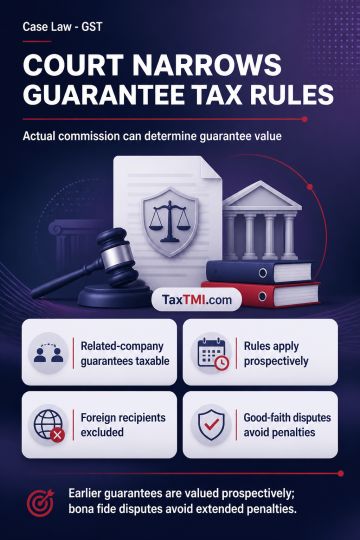
Corporate guarantee valuation permits actual ascertainable commission while barring retroactive application and extended-period penalties for bona fid...
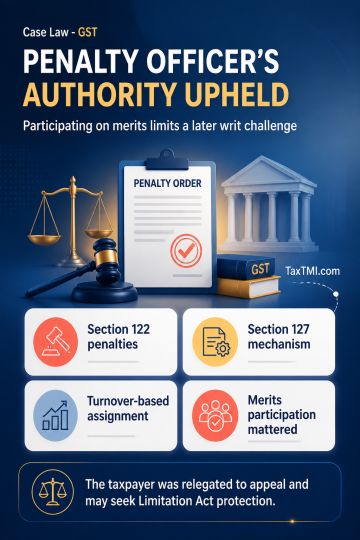
Proper-officer jurisdiction under UPGST penalty provisions upheld; participation on merits prevents bypassing the statutory appellate remedy through w...
Transitioned CENVAT credit may validly satisfy mandatory pre-deposit requirements for legacy service tax appeals through Electronic Credit Ledger debi...
Building-plan sanction charges require statutory authority; unauthorised fees and GST were quashed, while labour cess must follow prescribed collectio...
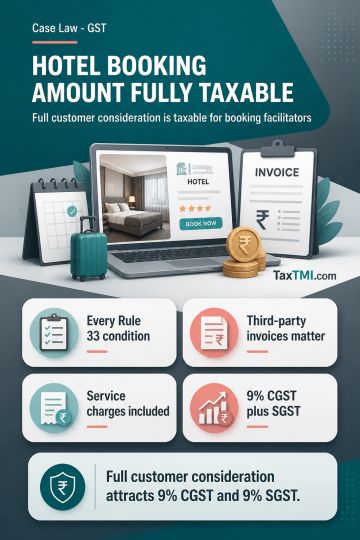
Pure-agent exclusion fails where hotel booking facilitators receive third-party services themselves, making entire customer consideration taxable as r...
The GST Council approved formation of a GoM on restructuring Compensation Cess to examine revenue impacts on states post-GST implementation. Key points: Karnataka raised concerns about revenue loss of approximately 0.7% of GSDP despite higher GST collections and growth rates compared to national average. The state clarified this was due to being a producer state under destination-based taxation. The Council agreed to form a GoM chaired by Minister of State (Finance) to: - Analyze state-wise revenue data considering COVID-19 impacts - Review compensation cess structure beyond March 2026 - Examine challenges faced by manufacturing states - Consider solutions within GST's destination-based framework Pre vs Post-GST comparison shows: - Pre-GST (2012-16): 8.3% growth rate, 11.5% GDP growth, 0.72 tax buoyancy - Post-GST (2018-23): 12.3% growth rate, 9.8% GDP growth, 1.25 tax buoyancy The GoM will submit detailed analysis and recommendations for Council's consideration before compensation cess expires in March 2026.
The GST Council approved formation of a GoM on restructuring Compensation Cess to examine revenue impacts on states post-GST implementation. Key points: Karnataka raised concerns about revenue loss of approximately 0.7% of GSDP despite higher GST collections and growth rates compared to national average. The state clarified this was due to being a producer state under destination-based taxation. The Council agreed to form a GoM chaired by Minister of State (Finance) to: - Analyze state-wise revenue data considering COVID-19 impacts - Review compensation cess structure beyond March 2026 - Examine challenges faced by manufacturing states - Consider solutions within GST's destination-based framework Pre vs Post-GST comparison shows: - Pre-GST (2012-16): 8.3% growth rate, 11.5% GDP growth, 0.72 tax buoyancy - Post-GST (2018-23): 12.3% growth rate, 9.8% GDP growth, 1.25 tax buoyancy The GoM will submit detailed analysis and recommendations for Council's consideration before compensation cess expires in March 2026.
Note: It is a system-generated summary and is for quick reference only.
 TaxTMI
 of 4800













 Join Channel


 TaxTMI