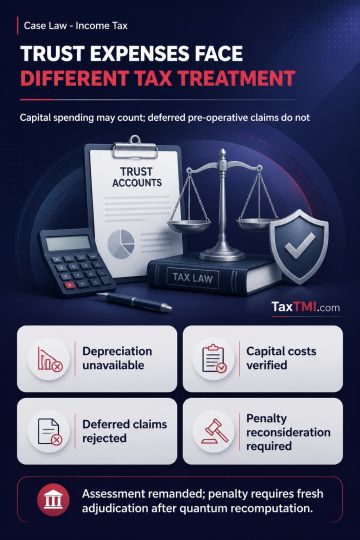
Charitable trust income application permits verified capital expenditure but rejects deferred pre-operative claims and requires reconsideration of con...
Reinsurance premium deductions require established regulatory breaches, while independently acquired software qualifies within the computer depreciati...
Rectification of mistake remains limited to self-evident record errors, preventing merits review through miscellaneous applications and preserving fin...
Tender creditworthiness conditions may extend to de facto Promoter Directors, with post-participation challenges generally barred absent arbitrariness...
Corporate representation in PMLA summons proceedings permitted through an authorised signatory, subject to directors' continuing cooperation and atten...
The GST Council approved formation of a GoM on restructuring Compensation Cess to examine revenue impacts on states post-GST implementation. Key points: Karnataka raised concerns about revenue loss of approximately 0.7% of GSDP despite higher GST collections and growth rates compared to national average. The state clarified this was due to being a producer state under destination-based taxation. The Council agreed to form a GoM chaired by Minister of State (Finance) to: - Analyze state-wise revenue data considering COVID-19 impacts - Review compensation cess structure beyond March 2026 - Examine challenges faced by manufacturing states - Consider solutions within GST's destination-based framework Pre vs Post-GST comparison shows: - Pre-GST (2012-16): 8.3% growth rate, 11.5% GDP growth, 0.72 tax buoyancy - Post-GST (2018-23): 12.3% growth rate, 9.8% GDP growth, 1.25 tax buoyancy The GoM will submit detailed analysis and recommendations for Council's consideration before compensation cess expires in March 2026.
The GST Council approved formation of a GoM on restructuring Compensation Cess to examine revenue impacts on states post-GST implementation. Key points: Karnataka raised concerns about revenue loss of approximately 0.7% of GSDP despite higher GST collections and growth rates compared to national average. The state clarified this was due to being a producer state under destination-based taxation. The Council agreed to form a GoM chaired by Minister of State (Finance) to: - Analyze state-wise revenue data considering COVID-19 impacts - Review compensation cess structure beyond March 2026 - Examine challenges faced by manufacturing states - Consider solutions within GST's destination-based framework Pre vs Post-GST comparison shows: - Pre-GST (2012-16): 8.3% growth rate, 11.5% GDP growth, 0.72 tax buoyancy - Post-GST (2018-23): 12.3% growth rate, 9.8% GDP growth, 1.25 tax buoyancy The GoM will submit detailed analysis and recommendations for Council's consideration before compensation cess expires in March 2026.
Note: It is a system-generated summary and is for quick reference only.
 TaxTMI
 of 4805
















 Join Channel


 TaxTMI
