Specified regulatory authority income receives conditional tax exemption, subject to non-commercial activity, unchanged income character, and return f...
Tax exemption for regulatory authority income applies retrospectively, subject to non-commercial activity, unchanged income sources, and return-filing...
Input tax credit conditions remain constitutionally valid, with eligible recipient claims considered under GST circulars and retrospective filing dead...
Bogus donation receipts justified commission income assessment and defeated political-party tax exemption for inaccurate accounts and reporting failur...
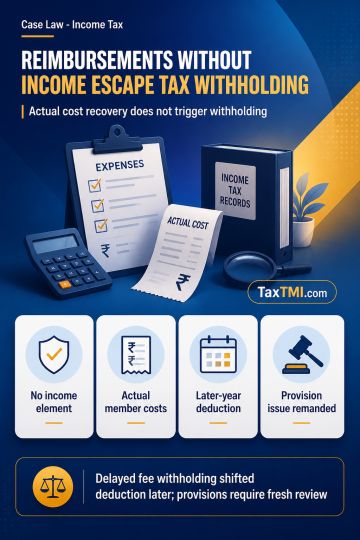
Pure reimbursement without income element escapes tax withholding, while delayed withholding and unsupported provisions face deferred or renewed scrut...
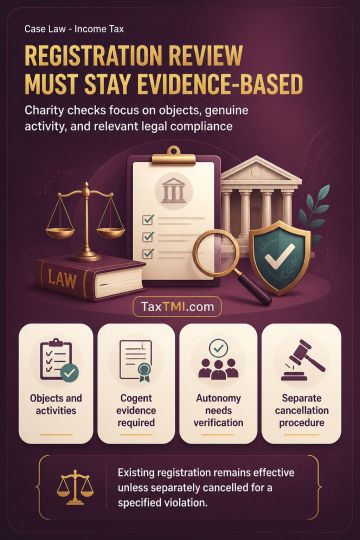
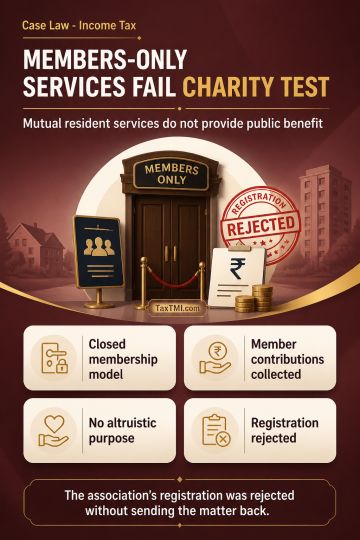
Public benefit requirement defeats charitable registration where residents' association services are reciprocal, member-only facilities governed by mu...
The GST Council approved formation of a GoM on restructuring Compensation Cess to examine revenue impacts on states post-GST implementation. Key points: Karnataka raised concerns about revenue loss of approximately 0.7% of GSDP despite higher GST collections and growth rates compared to national average. The state clarified this was due to being a producer state under destination-based taxation. The Council agreed to form a GoM chaired by Minister of State (Finance) to: - Analyze state-wise revenue data considering COVID-19 impacts - Review compensation cess structure beyond March 2026 - Examine challenges faced by manufacturing states - Consider solutions within GST's destination-based framework Pre vs Post-GST comparison shows: - Pre-GST (2012-16): 8.3% growth rate, 11.5% GDP growth, 0.72 tax buoyancy - Post-GST (2018-23): 12.3% growth rate, 9.8% GDP growth, 1.25 tax buoyancy The GoM will submit detailed analysis and recommendations for Council's consideration before compensation cess expires in March 2026.
The GST Council approved formation of a GoM on restructuring Compensation Cess to examine revenue impacts on states post-GST implementation. Key points: Karnataka raised concerns about revenue loss of approximately 0.7% of GSDP despite higher GST collections and growth rates compared to national average. The state clarified this was due to being a producer state under destination-based taxation. The Council agreed to form a GoM chaired by Minister of State (Finance) to: - Analyze state-wise revenue data considering COVID-19 impacts - Review compensation cess structure beyond March 2026 - Examine challenges faced by manufacturing states - Consider solutions within GST's destination-based framework Pre vs Post-GST comparison shows: - Pre-GST (2012-16): 8.3% growth rate, 11.5% GDP growth, 0.72 tax buoyancy - Post-GST (2018-23): 12.3% growth rate, 9.8% GDP growth, 1.25 tax buoyancy The GoM will submit detailed analysis and recommendations for Council's consideration before compensation cess expires in March 2026.
Note: It is a system-generated summary and is for quick reference only.
 TaxTMI
 of 4805















 Join Channel


 TaxTMI