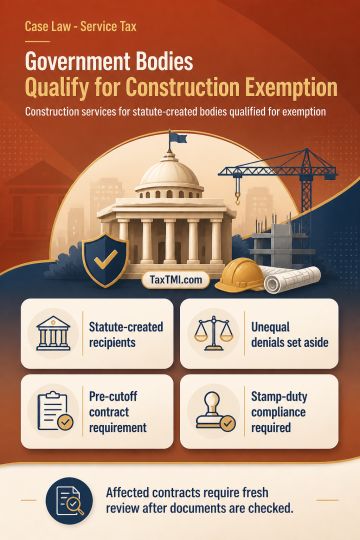
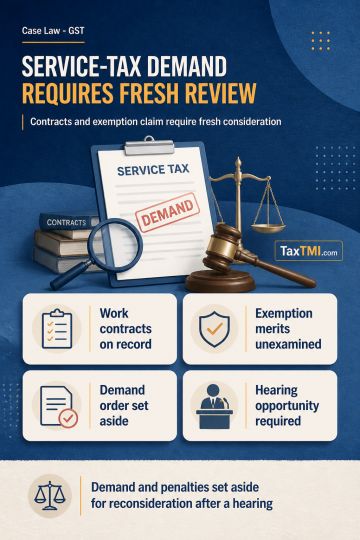
Governmental authority status supports construction-service exemption, while pre-cutoff contract and stamp-duty compliance requires verification on re...
Automated Free Sale and Commerce Certificates enable paperless processing while retaining risk-based manual verification for selected exporter applica...
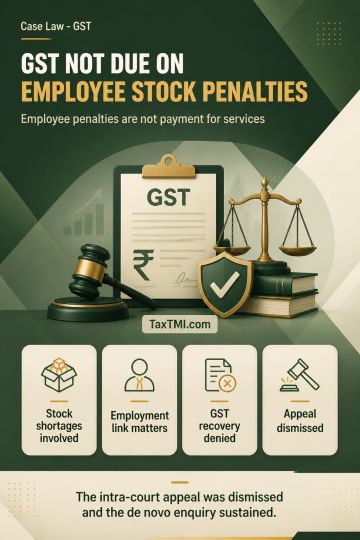
Employee stock-shortage penalties do not constitute consideration for services, preventing GST collection under Schedule II in employment relationship...
The ITAT upheld the CIT(A)'s order allowing deduction u/s 11, following the 'Principle of Consistency'. Despite payments to specified persons u/s 13(1)(c), the Revenue had allowed exemption in earlier years without adverse remarks. Applying Radhasoami Satsang, the ITAT ruled that without a change in facts or the earlier order being arbitrary/perverse, the Revenue cannot deviate from its consistent stance in subsequent years. Certainty and finality are essential, mandating consistent treatment unless material differences exist. The DR failed to demonstrate any infirmity or factual changes, leading to the decision against the Revenue.
The ITAT upheld the CIT(A)'s order allowing deduction u/s 11, following the 'Principle of Consistency'. Despite payments to specified persons u/s 13(1)(c), the Revenue had allowed exemption in earlier years without adverse remarks. Applying Radhasoami Satsang, the ITAT ruled that without a change in facts or the earlier order being arbitrary/perverse, the Revenue cannot deviate from its consistent stance in subsequent years. Certainty and finality are essential, mandating consistent treatment unless material differences exist. The DR failed to demonstrate any infirmity or factual changes, leading to the decision against the Revenue.
Note: It is a system-generated summary and is for quick reference only.
 TaxTMI
  TaxTMI
 of 4828











 Join Channel


