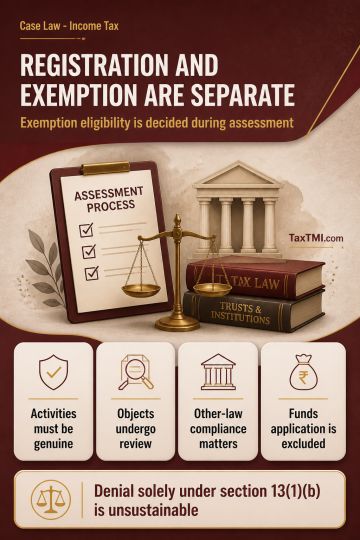
Defined public benefit can retain charitable character; registration renewal requires examining genuine activities and legal compliance, not surplus a...
Capital reduction is distinct from share buy-back, preventing buy-back tax; restructuring interest and related business deductions also survive scruti...
Transfer pricing and tax deductions upheld on established principles, while employee contributions and warranty provisions returned for fresh examinat...
Captive transfer pricing relies on industrial consumer tariffs, while genuine quotations can benchmark effluent treatment transfers under the Other Me...
The HC allowed the appeal, holding that the insertion of Section 5A(1A) in the Central Excise Act, 1944 is prospective, not clarificatory. Prior to the amendment, the appellant had the option to forego the exemption on final products and pay duty to claim CENVAT credit on inputs. However, post-amendment, manufacturers of exempted excisable goods are prohibited from paying duty, precluding them from claiming CENVAT credit. The Tribunal erred in upholding the demand of CENVAT credit where the appellant had paid duty on final products and utilized input credits.
The HC allowed the appeal, holding that the insertion of Section 5A(1A) in the Central Excise Act, 1944 is prospective, not clarificatory. Prior to the amendment, the appellant had the option to forego the exemption on final products and pay duty to claim CENVAT credit on inputs. However, post-amendment, manufacturers of exempted excisable goods are prohibited from paying duty, precluding them from claiming CENVAT credit. The Tribunal erred in upholding the demand of CENVAT credit where the appellant had paid duty on final products and utilized input credits.
Note: It is a system-generated summary and is for quick reference only.
 TaxTMI
  TaxTMI
 of 4819














 Join Channel


