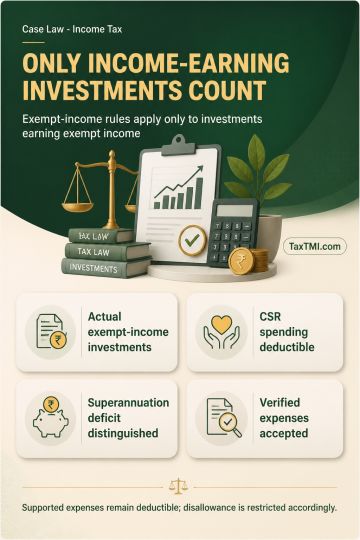
Exempt-income expenditure disallowance is confined to investments that actually generated exempt income, while supported business expenses remain dedu...
Objective characteristics and principal use govern mining-tyre classification, while fresh advance ruling applications may rely on additional technica...
Administrative fraud classification suspension does not halt independent criminal investigation or warrant-based searches into alleged economic offenc...
The HC allowed the appeal, holding that the insertion of Section 5A(1A) in the Central Excise Act, 1944 is prospective, not clarificatory. Prior to the amendment, the appellant had the option to forego the exemption on final products and pay duty to claim CENVAT credit on inputs. However, post-amendment, manufacturers of exempted excisable goods are prohibited from paying duty, precluding them from claiming CENVAT credit. The Tribunal erred in upholding the demand of CENVAT credit where the appellant had paid duty on final products and utilized input credits.
The HC allowed the appeal, holding that the insertion of Section 5A(1A) in the Central Excise Act, 1944 is prospective, not clarificatory. Prior to the amendment, the appellant had the option to forego the exemption on final products and pay duty to claim CENVAT credit on inputs. However, post-amendment, manufacturers of exempted excisable goods are prohibited from paying duty, precluding them from claiming CENVAT credit. The Tribunal erred in upholding the demand of CENVAT credit where the appellant had paid duty on final products and utilized input credits.
Note: It is a system-generated summary and is for quick reference only.
 TaxTMI
  TaxTMI
 of 4814
















 Join Channel