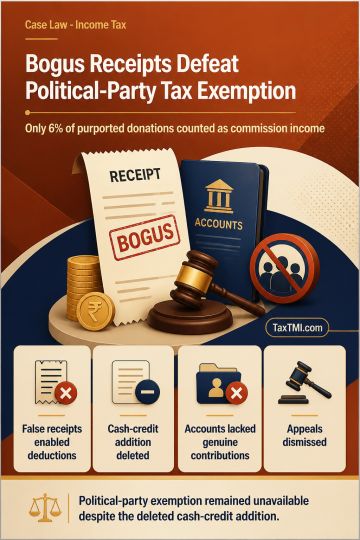
Bogus donation receipts justified commission income assessment and defeated political-party tax exemption for inaccurate accounts and reporting failur...
Pure reimbursement without income element escapes tax withholding, while delayed withholding and unsupported provisions face deferred or renewed scrut...
Public benefit requirement defeats charitable registration where residents' association services are reciprocal, member-only facilities governed by mu...
Exempt-income expenditure disallowance is confined to investments that actually generated exempt income, while supported business expenses remain dedu...
The ITAT held that neither the initiation of reassessment proceedings nor the addition made by the AO u/s 68 can be sustained. The AO drew an inference from an investigation wing report on bogus long/short-term capital gains transactions involving penny stocks to reopen the assessment against the assessee without considering the assessee's business nature and inquiries during regular scrutiny assessment. The sole basis for reassessment and addition was the assessee's sale of shares identified as penny stocks, which the ITAT found untenable. Regarding the addition u/s 68, the ITAT noted the CIT(A)'s observation of a sudden steep share price rise during a recessive market was unfounded, as the AO did not refer to quoted share prices. The CIT(A) also overlooked that the assessee booked a business loss. Thus, the assessee's appeal was allowed.
The ITAT held that neither the initiation of reassessment proceedings nor the addition made by the AO u/s 68 can be sustained. The AO drew an inference from an investigation wing report on bogus long/short-term capital gains transactions involving penny stocks to reopen the assessment against the assessee without considering the assessee's business nature and inquiries during regular scrutiny assessment. The sole basis for reassessment and addition was the assessee's sale of shares identified as penny stocks, which the ITAT found untenable. Regarding the addition u/s 68, the ITAT noted the CIT(A)'s observation of a sudden steep share price rise during a recessive market was unfounded, as the AO did not refer to quoted share prices. The CIT(A) also overlooked that the assessee booked a business loss. Thus, the assessee's appeal was allowed.
Note: It is a system-generated summary and is for quick reference only.
 TaxTMI
 of 4784

















 Join Channel


 TaxTMI