Threshold exemption excludes exempt services, while stamp-paper purchases avoid reverse charge; consequential service tax penalties were also set asid...
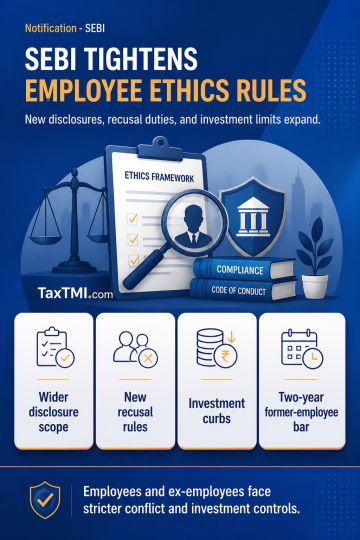
Employee conflict disclosures and investment restrictions expand with new recusal duties, post-employment limits, and compliance reporting requirement...
The CESTAT held that the expression 'liable to penalty' u/s 114AA of the Customs Act, 1962 means that a person who knowingly makes a false declaration may be penalised, but it does not mandate imposition of penalty. The adjudicating authority has discretion to judicially decide whether to impose penalty or not. Even if the case is decided against the appellant's firm for misdeclaration of machinery's year of manufacture to obtain EPCG license, the appellant cannot be penalised u/s 114AA as the alleged misdeclaration was not in any proceeding under the Customs Act but under the Foreign Trade Policy. Therefore, the appeal against the penalty imposed on the appellant u/s 114AA was allowed.
The CESTAT held that the expression 'liable to penalty' u/s 114AA of the Customs Act, 1962 means that a person who knowingly makes a false declaration may be penalised, but it does not mandate imposition of penalty. The adjudicating authority has discretion to judicially decide whether to impose penalty or not. Even if the case is decided against the appellant's firm for misdeclaration of machinery's year of manufacture to obtain EPCG license, the appellant cannot be penalised u/s 114AA as the alleged misdeclaration was not in any proceeding under the Customs Act but under the Foreign Trade Policy. Therefore, the appeal against the penalty imposed on the appellant u/s 114AA was allowed.
Note: It is a system-generated summary and is for quick reference only.
 TaxTMI
 of 4798











 Join Channel


 TaxTMI
