Additional evidence in transfer pricing dispute leads to fresh examination, while tax deductions, TDS credit, fee and refund interest require verifica...
Category II AIF pass-through taxation preserves non-business income character; investment receipts cannot be reclassified without applying recognised ...
Mutual fund maturity rules require proper rollover, redemption, disclosure, and due diligence; investor gains cannot excuse regulatory breaches or pen...
Threshold exemption excludes exempt services, while stamp-paper purchases avoid reverse charge; consequential service tax penalties were also set asid...
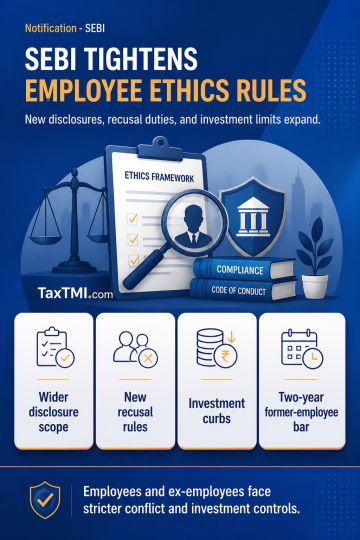
Employee conflict disclosures and investment restrictions expand with new recusal duties, post-employment limits, and compliance reporting requirement...
The SC held that an authorized signatory of a company does not fall within the ambit of the expression "drawer" u/s 138 of the Negotiable Instruments Act, 1881 (NI Act). The expression "on an account maintained by him" in Section 138 refers to the account maintained by the drawer and not by an authorized signatory acting on behalf of the company. The scope of "any debt or other liability" in Section 138 is wide enough to cover any legally enforceable debt or liability, not necessarily between the drawer and payee. u/s 141, the company as the principal offender must be first held liable before extending vicarious liability to directors or persons in-charge. Since the accused was prosecuted in individual capacity and not as director, and the cheque was drawn on the company's account, the requirements of Section 138 were not met. The appeal was dismissed.
The SC held that an authorized signatory of a company does not fall within the ambit of the expression "drawer" u/s 138 of the Negotiable Instruments Act, 1881 (NI Act). The expression "on an account maintained by him" in Section 138 refers to the account maintained by the drawer and not by an authorized signatory acting on behalf of the company. The scope of "any debt or other liability" in Section 138 is wide enough to cover any legally enforceable debt or liability, not necessarily between the drawer and payee. u/s 141, the company as the principal offender must be first held liable before extending vicarious liability to directors or persons in-charge. Since the accused was prosecuted in individual capacity and not as director, and the cheque was drawn on the company's account, the requirements of Section 138 were not met. The appeal was dismissed.
Note: It is a system-generated summary and is for quick reference only.
 TaxTMI
 of 4803



















 Join Channel


 TaxTMI
