Commercial vehicle depreciation, scientifically determined warranty provisions and exempt-income disallowances were resolved in favour of the taxpayer...
Inherited property sale proceeds require capital-gains treatment where ownership is supported by evidence, not suspicion or unverified signature doubt...
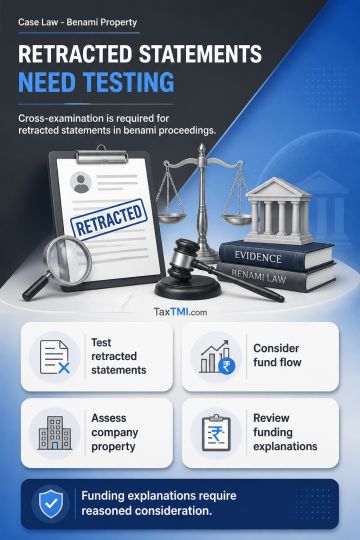
Cross-examination of retracted statements is essential where foundational evidence supports a benami allegation and documented funding explanations re...
Capital-goods exemption covers plant-modernisation accessories, while the import restriction applies only to earlier capital-goods components and spar...
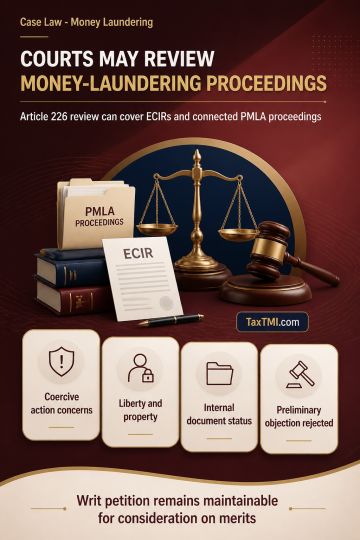
Constitutional judicial review permits challenges to ECIRs and connected money-laundering proceedings where coercive action affects fundamental intere...
The SC held that an authorized signatory of a company does not fall within the ambit of the expression "drawer" u/s 138 of the Negotiable Instruments Act, 1881 (NI Act). The expression "on an account maintained by him" in Section 138 refers to the account maintained by the drawer and not by an authorized signatory acting on behalf of the company. The scope of "any debt or other liability" in Section 138 is wide enough to cover any legally enforceable debt or liability, not necessarily between the drawer and payee. u/s 141, the company as the principal offender must be first held liable before extending vicarious liability to directors or persons in-charge. Since the accused was prosecuted in individual capacity and not as director, and the cheque was drawn on the company's account, the requirements of Section 138 were not met. The appeal was dismissed.
The SC held that an authorized signatory of a company does not fall within the ambit of the expression "drawer" u/s 138 of the Negotiable Instruments Act, 1881 (NI Act). The expression "on an account maintained by him" in Section 138 refers to the account maintained by the drawer and not by an authorized signatory acting on behalf of the company. The scope of "any debt or other liability" in Section 138 is wide enough to cover any legally enforceable debt or liability, not necessarily between the drawer and payee. u/s 141, the company as the principal offender must be first held liable before extending vicarious liability to directors or persons in-charge. Since the accused was prosecuted in individual capacity and not as director, and the cheque was drawn on the company's account, the requirements of Section 138 were not met. The appeal was dismissed.
Note: It is a system-generated summary and is for quick reference only.
 TaxTMI
 of 4782









 Join Channel


 TaxTMI
