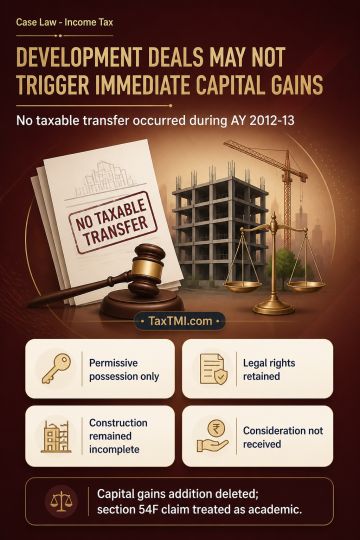
Development agreements require legal possession or effective enjoyment for capital gains transfer; permissive possession and deferred consideration de...
Prolonged sterilisation of development rights supports capital-gains treatment, while business-income disallowances cannot govern capital-gains comput...
Additional evidence in transfer pricing dispute leads to fresh examination, while tax deductions, TDS credit, fee and refund interest require verifica...
Category II AIF pass-through taxation preserves non-business income character; investment receipts cannot be reclassified without applying recognised ...
The ITAT allowed the assessee's appeal and held that the disallowance of interest expenditure claimed as a deduction against interest income from the partnership firm was not sustainable. The assessee had sourced funds from both interest-bearing loans and non-interest-bearing funds, which were majorly invested in the capital of partnership firms for business purposes. The revenue contended that since the investment did not earn any income except from one firm, the interest paid u/s 36(1)(iii) was not allowable. However, the ITAT observed that the commercial expediency must be considered for allowability u/s 36(1)(iii), and the revenue did not raise any contention in this regard. The ITAT noted that without establishing a one-to-one match, it cannot be said that the borrowed funds were used for giving interest-free loans and advances. As some loans extended were earning interest, the disallowance u/s 36(1)(iii) was not sustainable.
The ITAT allowed the assessee's appeal and held that the disallowance of interest expenditure claimed as a deduction against interest income from the partnership firm was not sustainable. The assessee had sourced funds from both interest-bearing loans and non-interest-bearing funds, which were majorly invested in the capital of partnership firms for business purposes. The revenue contended that since the investment did not earn any income except from one firm, the interest paid u/s 36(1)(iii) was not allowable. However, the ITAT observed that the commercial expediency must be considered for allowability u/s 36(1)(iii), and the revenue did not raise any contention in this regard. The ITAT noted that without establishing a one-to-one match, it cannot be said that the borrowed funds were used for giving interest-free loans and advances. As some loans extended were earning interest, the disallowance u/s 36(1)(iii) was not sustainable.
Note: It is a system-generated summary and is for quick reference only.
 TaxTMI
 of 4801













 Join Channel


 TaxTMI

