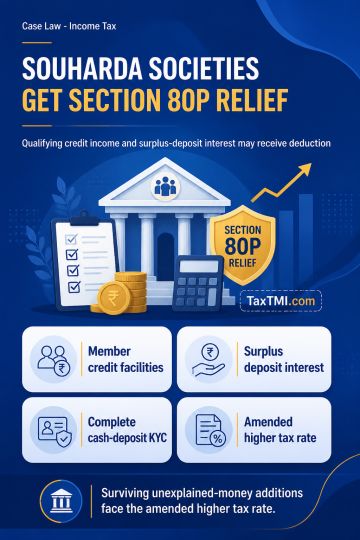
Section 80P deduction covers Souharda credit societies, including qualifying surplus-deposit interest, subject to member KYC verification for cash dep...
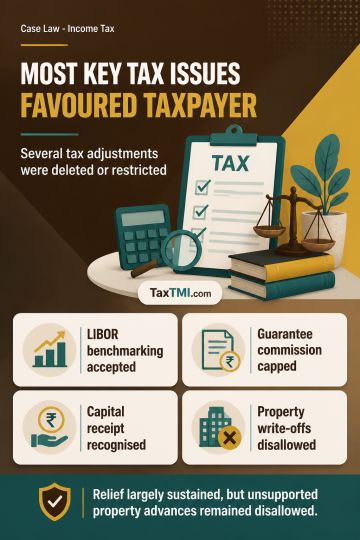
Transfer-pricing benchmarking and capital-receipt principles sustained taxpayer relief, while unsupported property-advance write-offs remained disallo...
Pre-existing operational debt disputes require genuine evidence, while undirected running-account payments may be appropriated on a first-in-first-out...
Page of 4794
Press 'Enter' after typing page number.
821 to 840 of 95875 Results
❮
❯
❯❯
0 / 200
Expand Note
Add to Folder
No Folders have been created
+
Are you sure you want to delete "My most important" ?
The ITAT allowed the assessee's appeal and held that the disallowance of interest expenditure claimed as a deduction against interest income from the partnership firm was not sustainable. The assessee had sourced funds from both interest-bearing loans and non-interest-bearing funds, which were majorly invested in the capital of partnership firms for business purposes. The revenue contended that since the investment did not earn any income except from one firm, the interest paid u/s 36(1)(iii) was not allowable. However, the ITAT observed that the commercial expediency must be considered for allowability u/s 36(1)(iii), and the revenue did not raise any contention in this regard. The ITAT noted that without establishing a one-to-one match, it cannot be said that the borrowed funds were used for giving interest-free loans and advances. As some loans extended were earning interest, the disallowance u/s 36(1)(iii) was not sustainable.
The ITAT allowed the assessee's appeal and held that the disallowance of interest expenditure claimed as a deduction against interest income from the partnership firm was not sustainable. The assessee had sourced funds from both interest-bearing loans and non-interest-bearing funds, which were majorly invested in the capital of partnership firms for business purposes. The revenue contended that since the investment did not earn any income except from one firm, the interest paid u/s 36(1)(iii) was not allowable. However, the ITAT observed that the commercial expediency must be considered for allowability u/s 36(1)(iii), and the revenue did not raise any contention in this regard. The ITAT noted that without establishing a one-to-one match, it cannot be said that the borrowed funds were used for giving interest-free loans and advances. As some loans extended were earning interest, the disallowance u/s 36(1)(iii) was not sustainable.
Note: It is a system-generated summary and is for quick reference only.
 TaxTMI
 of 4794













 Join Channel


 TaxTMI