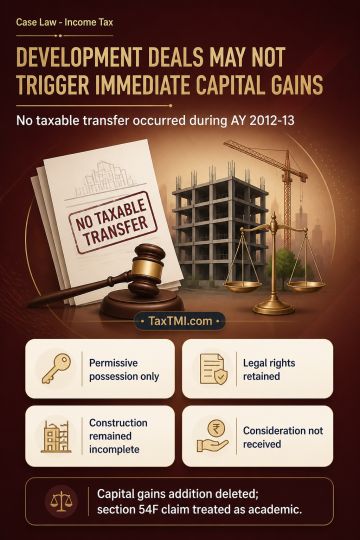
Development agreements require legal possession or effective enjoyment for capital gains transfer; permissive possession and deferred consideration de...
Prolonged sterilisation of development rights supports capital-gains treatment, while business-income disallowances cannot govern capital-gains comput...
Additional evidence in transfer pricing dispute leads to fresh examination, while tax deductions, TDS credit, fee and refund interest require verifica...
Category II AIF pass-through taxation preserves non-business income character; investment receipts cannot be reclassified without applying recognised ...
The appellant, a decree holder, qualifies as a "Financial Creditor" under the Insolvency and Bankruptcy Code (IBC). The settlement agreement recognized the appellant's financial claim, and the decree formalized the respondent's obligation to pay, not altering the underlying financial debt's character. The petition filed by the appellant u/s 7 of the IBC is within the limitation period. The respondent's acknowledgments of debt before the High Court extended the limitation period u/s 18 of the Limitation Act, 1963. The NCLT order dismissing the petition on the ground of limitation is erroneous and liable to be set aside. The appeal is allowed.
The appellant, a decree holder, qualifies as a "Financial Creditor" under the Insolvency and Bankruptcy Code (IBC). The settlement agreement recognized the appellant's financial claim, and the decree formalized the respondent's obligation to pay, not altering the underlying financial debt's character. The petition filed by the appellant u/s 7 of the IBC is within the limitation period. The respondent's acknowledgments of debt before the High Court extended the limitation period u/s 18 of the Limitation Act, 1963. The NCLT order dismissing the petition on the ground of limitation is erroneous and liable to be set aside. The appeal is allowed.
Note: It is a system-generated summary and is for quick reference only.
 TaxTMI
 of 4805











 Join Channel


 TaxTMI
