Governmental authority status supports construction-service exemption, while pre-cutoff contract and stamp-duty compliance requires verification on re...
Automated Free Sale and Commerce Certificates enable paperless processing while retaining risk-based manual verification for selected exporter applica...
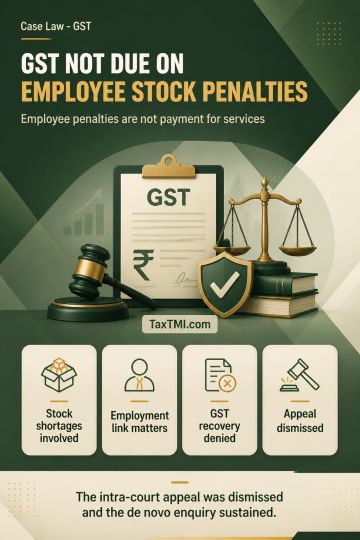
Employee stock-shortage penalties do not constitute consideration for services, preventing GST collection under Schedule II in employment relationship...
The plaintiffs/appellants, as universal legatees of the estate of Late Smt. Priyamvada Debi Birla, lack legal standing to initiate the suit seeking a declaration that the decision taken by the defendant/respondent-Company to obtain leasehold rights is illegal and void. Section 211 of the Indian Succession Act, 1925 vests the property of the deceased in the Administrator Pendente Lite (APL) appointed by the Testamentary Court, making the APL the legal representative. The plaintiffs, as legatees, cannot bypass the APL and assert rights over the estate directly. Their remedy, if aggrieved by the APL's functioning, lies in approaching the Testamentary Court. The plaintiffs are not "members" of the defendant-companies and cannot invoke the NCLT's jurisdiction u/ss 241 and 242 of the Companies Act, 2013. The High Court dismissed the application for interim injunction, finding the Single Judge's reasoned order justified and not warranting interference.
The plaintiffs/appellants, as universal legatees of the estate of Late Smt. Priyamvada Debi Birla, lack legal standing to initiate the suit seeking a declaration that the decision taken by the defendant/respondent-Company to obtain leasehold rights is illegal and void. Section 211 of the Indian Succession Act, 1925 vests the property of the deceased in the Administrator Pendente Lite (APL) appointed by the Testamentary Court, making the APL the legal representative. The plaintiffs, as legatees, cannot bypass the APL and assert rights over the estate directly. Their remedy, if aggrieved by the APL's functioning, lies in approaching the Testamentary Court. The plaintiffs are not "members" of the defendant-companies and cannot invoke the NCLT's jurisdiction u/ss 241 and 242 of the Companies Act, 2013. The High Court dismissed the application for interim injunction, finding the Single Judge's reasoned order justified and not warranting interference.
Note: It is a system-generated summary and is for quick reference only.
 TaxTMI
  TaxTMI
 of 4828














 Join Channel


