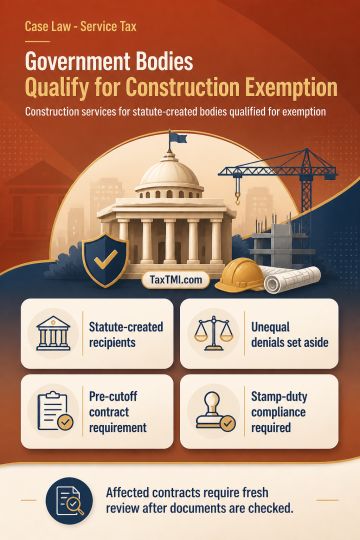
Governmental authority status supports construction-service exemption, while pre-cutoff contract and stamp-duty compliance requires verification on re...
Automated Free Sale and Commerce Certificates enable paperless processing while retaining risk-based manual verification for selected exporter applica...
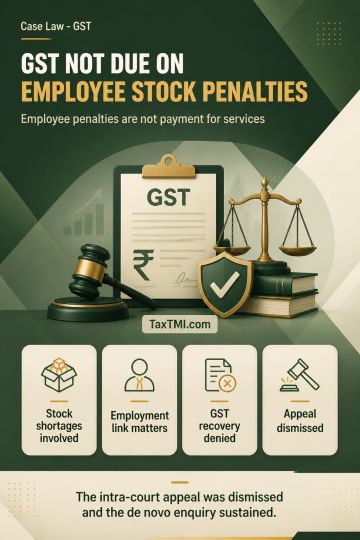
Employee stock-shortage penalties do not constitute consideration for services, preventing GST collection under Schedule II in employment relationship...
The assessee had not obtained and furnished the Audit Report from the Accountant within the due date. The Tribunal held that the levy of penalty u/s 271B is not automatic. Before levying penalty, the concerned officer must find that the failure was without reasonable cause. The initial burden is on the assessee to show reasonable cause for the failure. 'Reasonable cause' means an honest belief founded on reasonable grounds that the action was the right thing to do. In this case, as it was the first year of audit and the assessee had not filed returns previously due to income below the taxable limit, the assessee was unaware of the requirement to file the audit report by the due date. The assessee believed the report could be filed along with the return u/s 139(4). The Tribunal found it was a technical breach without any loss to the government, and the audit report was made available before assessment completion. Considering the assessee's bonafide intention and lack of malafide, the penalty u/s 271B was not leviable. The assessee's appeal was allowed.
The assessee had not obtained and furnished the Audit Report from the Accountant within the due date. The Tribunal held that the levy of penalty u/s 271B is not automatic. Before levying penalty, the concerned officer must find that the failure was without reasonable cause. The initial burden is on the assessee to show reasonable cause for the failure. 'Reasonable cause' means an honest belief founded on reasonable grounds that the action was the right thing to do. In this case, as it was the first year of audit and the assessee had not filed returns previously due to income below the taxable limit, the assessee was unaware of the requirement to file the audit report by the due date. The assessee believed the report could be filed along with the return u/s 139(4). The Tribunal found it was a technical breach without any loss to the government, and the audit report was made available before assessment completion. Considering the assessee's bonafide intention and lack of malafide, the penalty u/s 271B was not leviable. The assessee's appeal was allowed.
Note: It is a system-generated summary and is for quick reference only.
 TaxTMI
  TaxTMI
 of 4828









 Join Channel


