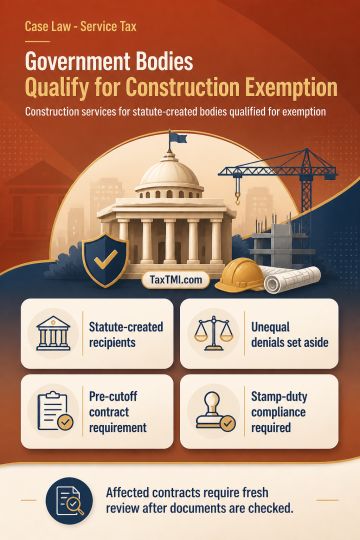
Governmental authority status supports construction-service exemption, while pre-cutoff contract and stamp-duty compliance requires verification on re...
Automated Free Sale and Commerce Certificates enable paperless processing while retaining risk-based manual verification for selected exporter applica...
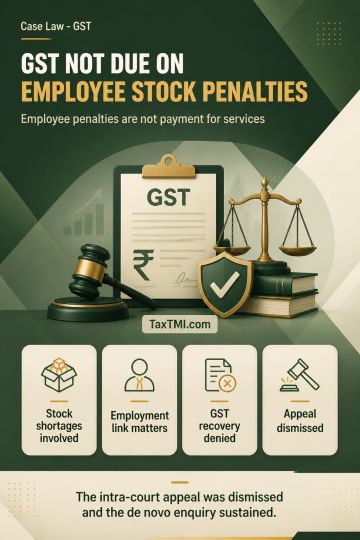
Employee stock-shortage penalties do not constitute consideration for services, preventing GST collection under Schedule II in employment relationship...
The Income Tax Appellate Tribunal (ITAT) decided the following: Disallowance of proportionate interest expenses was unjustified as the assessee had sufficient interest-free funds exceeding the non-income-generating investments. The Assessing Officer (AO) failed to establish a direct nexus between borrowed funds and investments, rendering the disallowance unsustainable. The Tribunal held in favor of the assessee on this issue. Additions u/s 68 for unexplained cash credits were deleted. The assessee explained the sources of cash deposits, including business receipts, pre-existing cash balances, and sale proceeds. The AO did not verify the lenders' creditworthiness, shifting the burden of proof to the Revenue. The Tribunal found the loans sufficiently substantiated and decided in favor of the assessee. Regarding the disallowance of cost of improvement while calculating capital gains, the Tribunal restricted the disallowance to 10% of the claimed expenses. While invoices substantiated most expenses, the lack of full corroboration warranted a reasonable adjustment. A 10% disallowance struck a balance between recognizing genuine costs and addressing Revenue's concerns. The addition of a bogus gift receipt treated as unexplained cash credit u/s 68 was deleted. The assessee provided adequate evidence, including a signed confirmation.
The Income Tax Appellate Tribunal (ITAT) decided the following: Disallowance of proportionate interest expenses was unjustified as the assessee had sufficient interest-free funds exceeding the non-income-generating investments. The Assessing Officer (AO) failed to establish a direct nexus between borrowed funds and investments, rendering the disallowance unsustainable. The Tribunal held in favor of the assessee on this issue. Additions u/s 68 for unexplained cash credits were deleted. The assessee explained the sources of cash deposits, including business receipts, pre-existing cash balances, and sale proceeds. The AO did not verify the lenders' creditworthiness, shifting the burden of proof to the Revenue. The Tribunal found the loans sufficiently substantiated and decided in favor of the assessee. Regarding the disallowance of cost of improvement while calculating capital gains, the Tribunal restricted the disallowance to 10% of the claimed expenses. While invoices substantiated most expenses, the lack of full corroboration warranted a reasonable adjustment. A 10% disallowance struck a balance between recognizing genuine costs and addressing Revenue's concerns. The addition of a bogus gift receipt treated as unexplained cash credit u/s 68 was deleted. The assessee provided adequate evidence, including a signed confirmation.
Note: It is a system-generated summary and is for quick reference only.
 TaxTMI
  TaxTMI
 of 4828








 Join Channel


