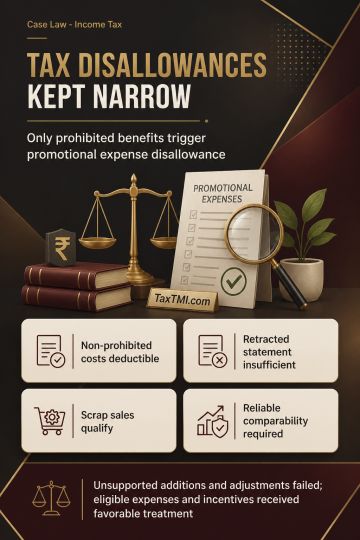
Pharmaceutical promotion and transfer-pricing comparability principles limited disallowances, while uncorroborated search allegations and unsupported ...
Business expenditure substantiation supports scrap credits, statutory payments and expense claims, while depreciation requires proof of actual busines...
The Income Tax Appellate Tribunal (ITAT) held that the final assessment order passed by the Assessing Officer (AO) u/s 144C(4) read with Section 147 of the Income Tax Act was barred by limitation and void ab initio. The assessee had received the draft assessment order on 27.05.2023, and the due date for filing objections before the Dispute Resolution Panel (DRP) u/s 144C(2) was 26.06.2023. However, the assessee filed the objections on 06.07.2023, beyond the prescribed one-month time limit. Consequently, the AO was mandatorily required to pass the final assessment order by 31.07.2023. However, the AO passed the final order on 04.03.2024, well beyond the prescribed time limit. The ITAT held that by not adhering to the mandatory time limit, the final assessment order was barred by limitation and liable to be quashed.
The Income Tax Appellate Tribunal (ITAT) held that the final assessment order passed by the Assessing Officer (AO) u/s 144C(4) read with Section 147 of the Income Tax Act was barred by limitation and void ab initio. The assessee had received the draft assessment order on 27.05.2023, and the due date for filing objections before the Dispute Resolution Panel (DRP) u/s 144C(2) was 26.06.2023. However, the assessee filed the objections on 06.07.2023, beyond the prescribed one-month time limit. Consequently, the AO was mandatorily required to pass the final assessment order by 31.07.2023. However, the AO passed the final order on 04.03.2024, well beyond the prescribed time limit. The ITAT held that by not adhering to the mandatory time limit, the final assessment order was barred by limitation and liable to be quashed.
Note: It is a system-generated summary and is for quick reference only.
 TaxTMI
  TaxTMI
 of 4814







 Join Channel


