Additional evidence in transfer pricing dispute leads to fresh examination, while tax deductions, TDS credit, fee and refund interest require verifica...
Category II AIF pass-through taxation preserves non-business income character; investment receipts cannot be reclassified without applying recognised ...
Mutual fund maturity rules require proper rollover, redemption, disclosure, and due diligence; investor gains cannot excuse regulatory breaches or pen...
Threshold exemption excludes exempt services, while stamp-paper purchases avoid reverse charge; consequential service tax penalties were also set asid...
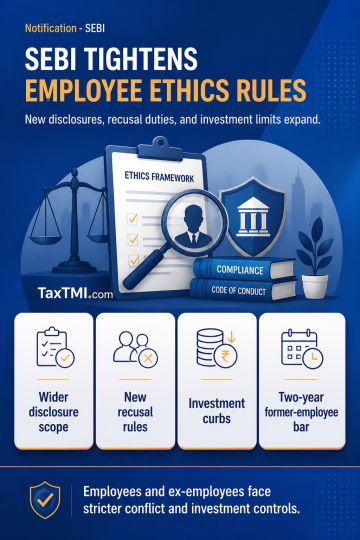
Employee conflict disclosures and investment restrictions expand with new recusal duties, post-employment limits, and compliance reporting requirement...
The High Court held that while exercising jurisdiction under Article 226 of the Constitution, it does not assume the role of an appellate authority to conduct a merit review of orders passed by the Income Tax Settlement Commission. Its role is confined to judicial review by applying well-settled principles. The Court would be concerned with the decision-making process adopted by the Commission, not the decision itself. The scope of inquiry is limited to whether the Commission's order complies with statutory provisions of Chapter XIX-A of the Income Tax Act. The Court cannot decide on facts or interpretation of documents. A defect vitiating a settlement must vitiate the whole, not merely a part. A settlement partakes the nature of a negotiated contract with a "give and take." The settlement must fail or succeed as a whole, as partial acceptance is not envisaged under the Income Tax Act. The Court must defer to the statutory finality envisaged for settlement while exercising judicial review. The Writ Appeal was dismissed.
The High Court held that while exercising jurisdiction under Article 226 of the Constitution, it does not assume the role of an appellate authority to conduct a merit review of orders passed by the Income Tax Settlement Commission. Its role is confined to judicial review by applying well-settled principles. The Court would be concerned with the decision-making process adopted by the Commission, not the decision itself. The scope of inquiry is limited to whether the Commission's order complies with statutory provisions of Chapter XIX-A of the Income Tax Act. The Court cannot decide on facts or interpretation of documents. A defect vitiating a settlement must vitiate the whole, not merely a part. A settlement partakes the nature of a negotiated contract with a "give and take." The settlement must fail or succeed as a whole, as partial acceptance is not envisaged under the Income Tax Act. The Court must defer to the statutory finality envisaged for settlement while exercising judicial review. The Writ Appeal was dismissed.
Note: It is a system-generated summary and is for quick reference only.
 TaxTMI
  TaxTMI
 of 4819

















 Join Channel


