Minimum alternate tax exclusions for pre-amendment banking companies and expatriate Indian branch salaries remain outside head office expenditure limi...
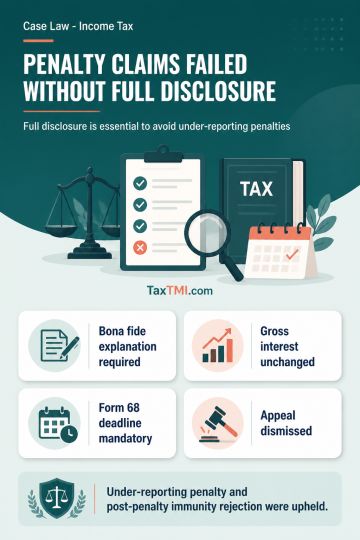
Bona fide disclosure requirements govern under-reporting penalties, and post-penalty immunity applications cannot secure available statutory protectio...
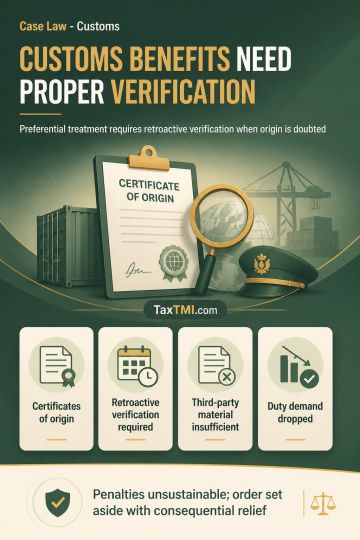
Certificate-of-origin verification procedure governs preferential customs benefits; denial without retroactive verification was set aside with consequ...
Disciplinary Committee jurisdiction and mandatory investigation requirements invalidated cancellation of an insolvency professional's registration and...
Page of 4819
Press 'Enter' after typing page number.
1481 to 1500 of 96363 Results
❮
❯
❯❯
0 / 200
Expand Note
Add to Folder
No Folders have been created
+
Are you sure you want to delete "My most important" ?
The High Court held that while exercising jurisdiction under Article 226 of the Constitution, it does not assume the role of an appellate authority to conduct a merit review of orders passed by the Income Tax Settlement Commission. Its role is confined to judicial review by applying well-settled principles. The Court would be concerned with the decision-making process adopted by the Commission, not the decision itself. The scope of inquiry is limited to whether the Commission's order complies with statutory provisions of Chapter XIX-A of the Income Tax Act. The Court cannot decide on facts or interpretation of documents. A defect vitiating a settlement must vitiate the whole, not merely a part. A settlement partakes the nature of a negotiated contract with a "give and take." The settlement must fail or succeed as a whole, as partial acceptance is not envisaged under the Income Tax Act. The Court must defer to the statutory finality envisaged for settlement while exercising judicial review. The Writ Appeal was dismissed.
The High Court held that while exercising jurisdiction under Article 226 of the Constitution, it does not assume the role of an appellate authority to conduct a merit review of orders passed by the Income Tax Settlement Commission. Its role is confined to judicial review by applying well-settled principles. The Court would be concerned with the decision-making process adopted by the Commission, not the decision itself. The scope of inquiry is limited to whether the Commission's order complies with statutory provisions of Chapter XIX-A of the Income Tax Act. The Court cannot decide on facts or interpretation of documents. A defect vitiating a settlement must vitiate the whole, not merely a part. A settlement partakes the nature of a negotiated contract with a "give and take." The settlement must fail or succeed as a whole, as partial acceptance is not envisaged under the Income Tax Act. The Court must defer to the statutory finality envisaged for settlement while exercising judicial review. The Writ Appeal was dismissed.
Note: It is a system-generated summary and is for quick reference only.
 TaxTMI
  TaxTMI
 of 4819









 Join Channel