Extended limitation fails without specific suppression allegations, while overseas employee secondment remains taxable as manpower supply within norma...
Time-share accommodation classification excludes Club or Association Service where purchasers receive contractual occupancy rights without genuine mem...
CENVAT credit for trading requires reversal, while taxable-service rental credit remains proportionately available and limitation issues await resolut...
Vicarious liability for dishonoured company cheques may extend to non-signatory directors where complaints contain foundational responsibility avermen...
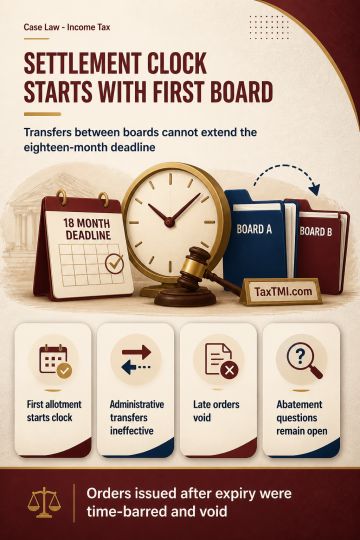
The High Court held that while exercising jurisdiction under Article 226 of the Constitution, it does not assume the role of an appellate authority to conduct a merit review of orders passed by the Income Tax Settlement Commission. Its role is confined to judicial review by applying well-settled principles. The Court would be concerned with the decision-making process adopted by the Commission, not the decision itself. The scope of inquiry is limited to whether the Commission's order complies with statutory provisions of Chapter XIX-A of the Income Tax Act. The Court cannot decide on facts or interpretation of documents. A defect vitiating a settlement must vitiate the whole, not merely a part. A settlement partakes the nature of a negotiated contract with a "give and take." The settlement must fail or succeed as a whole, as partial acceptance is not envisaged under the Income Tax Act. The Court must defer to the statutory finality envisaged for settlement while exercising judicial review. The Writ Appeal was dismissed.
The High Court held that while exercising jurisdiction under Article 226 of the Constitution, it does not assume the role of an appellate authority to conduct a merit review of orders passed by the Income Tax Settlement Commission. Its role is confined to judicial review by applying well-settled principles. The Court would be concerned with the decision-making process adopted by the Commission, not the decision itself. The scope of inquiry is limited to whether the Commission's order complies with statutory provisions of Chapter XIX-A of the Income Tax Act. The Court cannot decide on facts or interpretation of documents. A defect vitiating a settlement must vitiate the whole, not merely a part. A settlement partakes the nature of a negotiated contract with a "give and take." The settlement must fail or succeed as a whole, as partial acceptance is not envisaged under the Income Tax Act. The Court must defer to the statutory finality envisaged for settlement while exercising judicial review. The Writ Appeal was dismissed.
Note: It is a system-generated summary and is for quick reference only.
 TaxTMI
  TaxTMI
 of 4807












 Join Channel


