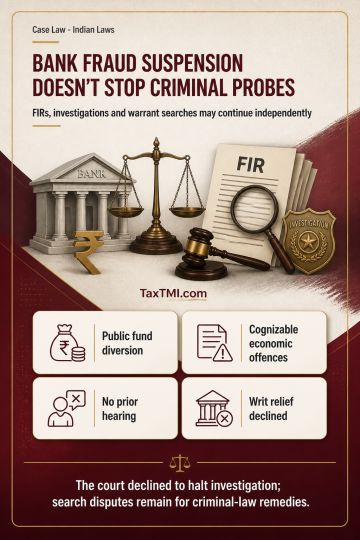
Administrative fraud classification suspension does not halt independent criminal investigation or warrant-based searches into alleged economic offenc...
Arrest safeguards and transit remand requirements invalidated detention following inter-State transfer without communicated grounds or magistrate auth...
Arrest safeguards require disclosed grounds, relative intimation and transit remand, while duplicate prosecution under the CGST framework is unsustain...
Document Identification Number defects can invalidate GST assessments, with delayed challenges entertained conditionally where patent irregularities e...
The Income Tax Appellate Tribunal (ITAT) held that the assessee's transactions involving purchases and sales on a High Seas Sales (HSS) basis did not constitute speculative transactions. The ITAT observed that under the Act, the term "speculation" focuses on whether the transactions involve actual delivery, transfer, or settlement. In the assessee's case, the entire transaction involved a process where delivery of goods took place, evidenced by documents like the Bill of Lading, which was not disputed by the revenue authorities. The ITAT found that the assessee physically purchased goods from a foreign seller, sold them to an importer while on high seas, and the ultimate buyer took delivery by filing the bill of entry and complying with customs formalities. Since the factual sequence of events and documentary evidence regarding the ultimate delivery were not disputed, the ITAT concluded that the transactions did not amount to speculation. Consequently, the assessee's appeal was allowed.
The Income Tax Appellate Tribunal (ITAT) held that the assessee's transactions involving purchases and sales on a High Seas Sales (HSS) basis did not constitute speculative transactions. The ITAT observed that under the Act, the term "speculation" focuses on whether the transactions involve actual delivery, transfer, or settlement. In the assessee's case, the entire transaction involved a process where delivery of goods took place, evidenced by documents like the Bill of Lading, which was not disputed by the revenue authorities. The ITAT found that the assessee physically purchased goods from a foreign seller, sold them to an importer while on high seas, and the ultimate buyer took delivery by filing the bill of entry and complying with customs formalities. Since the factual sequence of events and documentary evidence regarding the ultimate delivery were not disputed, the ITAT concluded that the transactions did not amount to speculation. Consequently, the assessee's appeal was allowed.
Note: It is a system-generated summary and is for quick reference only.
 TaxTMI
  TaxTMI
 of 4811







 Join Channel




