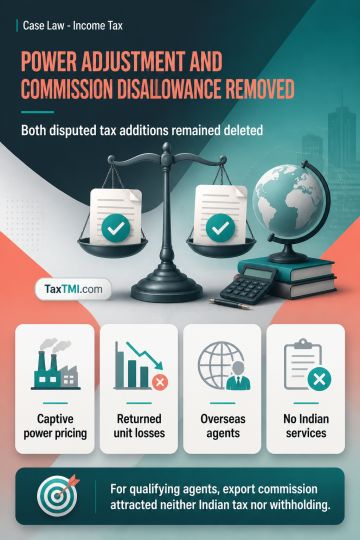
Captive power transfer pricing and non-resident export commission rules support deletion of adjustments and withholding disallowance in discussed proc...
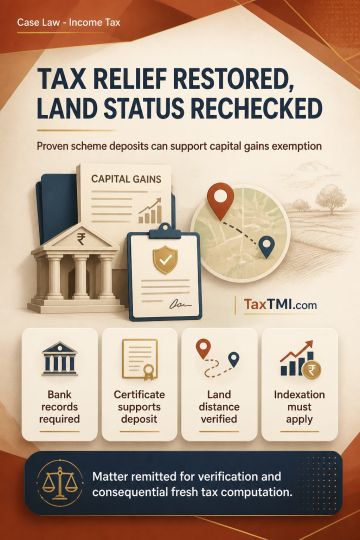
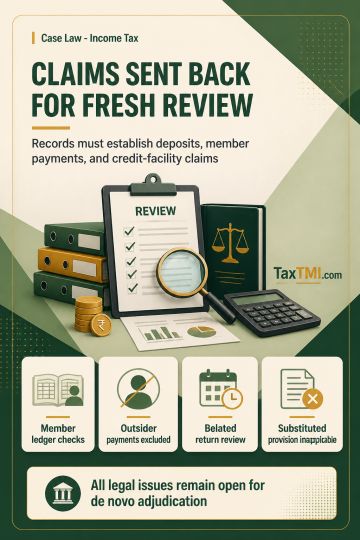
Cooperative society deposits, member-interest TDS exemption and credit-facility deduction claims require verification through records and supporting e...
Customs jurisdiction over EPCG condition breaches survives export-obligation discharge certificates, requiring alleged fraud and misdeclaration to be ...
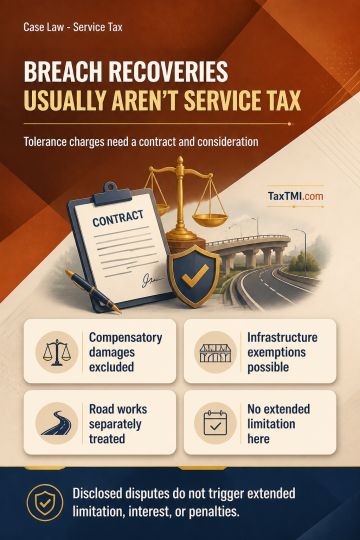
Contractual tolerance requires consideration; breach recoveries, qualifying public infrastructure services and road works escape service tax liability...
The CESTAT held that the demand of Rs.80,61,111/- (including Education Cess and Secondary and Higher Education Cess) raised on the ground of difference between the taxable value recorded in Service Tax returns and the income shown in the Balance Sheet and Profit & Loss Account is not sustainable. The appellant had not suppressed any information from the Department, and there was no mala fide intent or intention to evade payment of tax established. Invoking the extended period of limitation was not justified as per the Supreme Court's judgment in Nirlon Ltd. case. The entire demand of Service Tax for the financial years 2007-08 to 2010-11 was set aside on the ground of limitation. The demand of Rs.46,931/- on advances received from customers was also set aside as these were refundable security deposits not liable to Service Tax. However, the appellant was eligible to avail the CENVAT Credit of Rs.69,73,243/- as the input invoices met the requirements under the CENVAT Credit Rules. Consequently, the penalties imposed u/s 78 of the Finance Act and Rule 15(2) of the CENVAT Credit Rules were also set aside.
The CESTAT held that the demand of Rs.80,61,111/- (including Education Cess and Secondary and Higher Education Cess) raised on the ground of difference between the taxable value recorded in Service Tax returns and the income shown in the Balance Sheet and Profit & Loss Account is not sustainable. The appellant had not suppressed any information from the Department, and there was no mala fide intent or intention to evade payment of tax established. Invoking the extended period of limitation was not justified as per the Supreme Court's judgment in Nirlon Ltd. case. The entire demand of Service Tax for the financial years 2007-08 to 2010-11 was set aside on the ground of limitation. The demand of Rs.46,931/- on advances received from customers was also set aside as these were refundable security deposits not liable to Service Tax. However, the appellant was eligible to avail the CENVAT Credit of Rs.69,73,243/- as the input invoices met the requirements under the CENVAT Credit Rules. Consequently, the penalties imposed u/s 78 of the Finance Act and Rule 15(2) of the CENVAT Credit Rules were also set aside.
Note: It is a system-generated summary and is for quick reference only.
 TaxTMI
  TaxTMI
 of 4809







 Join Channel