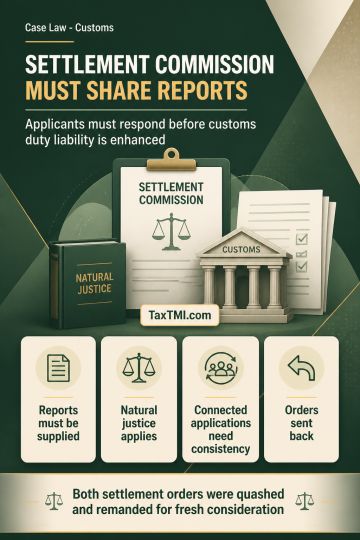
Opportunity to respond to jurisdictional reports is mandatory before customs settlement duty enhancement; connected applications require consistent ad...
Specific customs headings for scaffolding components prevail over general classification, invalidating misclassification proceedings and enabling with...
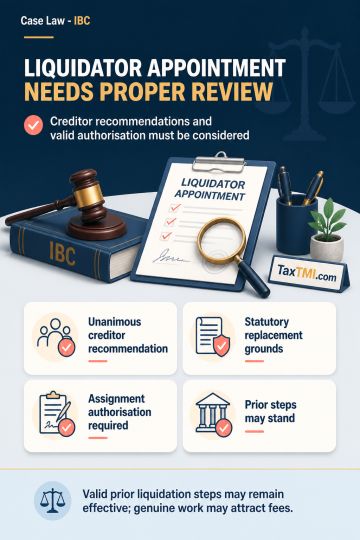
Liquidator appointment under Section 34 requires consideration of creditor recommendations, valid professional authorisation, and preservation of vali...
Page of 4809
Press 'Enter' after typing page number.
741 to 760 of 96174 Results
❮
❯
❯❯
0 / 200
Expand Note
Add to Folder
No Folders have been created
+
Are you sure you want to delete "My most important" ?
The CESTAT held that the demand of Rs.80,61,111/- (including Education Cess and Secondary and Higher Education Cess) raised on the ground of difference between the taxable value recorded in Service Tax returns and the income shown in the Balance Sheet and Profit & Loss Account is not sustainable. The appellant had not suppressed any information from the Department, and there was no mala fide intent or intention to evade payment of tax established. Invoking the extended period of limitation was not justified as per the Supreme Court's judgment in Nirlon Ltd. case. The entire demand of Service Tax for the financial years 2007-08 to 2010-11 was set aside on the ground of limitation. The demand of Rs.46,931/- on advances received from customers was also set aside as these were refundable security deposits not liable to Service Tax. However, the appellant was eligible to avail the CENVAT Credit of Rs.69,73,243/- as the input invoices met the requirements under the CENVAT Credit Rules. Consequently, the penalties imposed u/s 78 of the Finance Act and Rule 15(2) of the CENVAT Credit Rules were also set aside.
The CESTAT held that the demand of Rs.80,61,111/- (including Education Cess and Secondary and Higher Education Cess) raised on the ground of difference between the taxable value recorded in Service Tax returns and the income shown in the Balance Sheet and Profit & Loss Account is not sustainable. The appellant had not suppressed any information from the Department, and there was no mala fide intent or intention to evade payment of tax established. Invoking the extended period of limitation was not justified as per the Supreme Court's judgment in Nirlon Ltd. case. The entire demand of Service Tax for the financial years 2007-08 to 2010-11 was set aside on the ground of limitation. The demand of Rs.46,931/- on advances received from customers was also set aside as these were refundable security deposits not liable to Service Tax. However, the appellant was eligible to avail the CENVAT Credit of Rs.69,73,243/- as the input invoices met the requirements under the CENVAT Credit Rules. Consequently, the penalties imposed u/s 78 of the Finance Act and Rule 15(2) of the CENVAT Credit Rules were also set aside.
Note: It is a system-generated summary and is for quick reference only.
 TaxTMI
  TaxTMI
 of 4809






 Join Channel