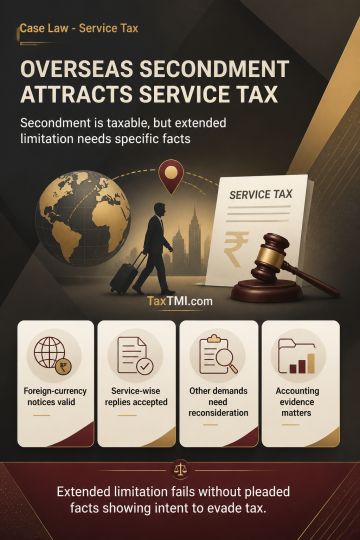
Extended limitation fails without specific suppression allegations, while overseas employee secondment remains taxable as manpower supply within norma...
Time-share accommodation classification excludes Club or Association Service where purchasers receive contractual occupancy rights without genuine mem...
CENVAT credit for trading requires reversal, while taxable-service rental credit remains proportionately available and limitation issues await resolut...
Vicarious liability for dishonoured company cheques may extend to non-signatory directors where complaints contain foundational responsibility avermen...
The CESTAT held that the demand of Rs.80,61,111/- (including Education Cess and Secondary and Higher Education Cess) raised on the ground of difference between the taxable value recorded in Service Tax returns and the income shown in the Balance Sheet and Profit & Loss Account is not sustainable. The appellant had not suppressed any information from the Department, and there was no mala fide intent or intention to evade payment of tax established. Invoking the extended period of limitation was not justified as per the Supreme Court's judgment in Nirlon Ltd. case. The entire demand of Service Tax for the financial years 2007-08 to 2010-11 was set aside on the ground of limitation. The demand of Rs.46,931/- on advances received from customers was also set aside as these were refundable security deposits not liable to Service Tax. However, the appellant was eligible to avail the CENVAT Credit of Rs.69,73,243/- as the input invoices met the requirements under the CENVAT Credit Rules. Consequently, the penalties imposed u/s 78 of the Finance Act and Rule 15(2) of the CENVAT Credit Rules were also set aside.
The CESTAT held that the demand of Rs.80,61,111/- (including Education Cess and Secondary and Higher Education Cess) raised on the ground of difference between the taxable value recorded in Service Tax returns and the income shown in the Balance Sheet and Profit & Loss Account is not sustainable. The appellant had not suppressed any information from the Department, and there was no mala fide intent or intention to evade payment of tax established. Invoking the extended period of limitation was not justified as per the Supreme Court's judgment in Nirlon Ltd. case. The entire demand of Service Tax for the financial years 2007-08 to 2010-11 was set aside on the ground of limitation. The demand of Rs.46,931/- on advances received from customers was also set aside as these were refundable security deposits not liable to Service Tax. However, the appellant was eligible to avail the CENVAT Credit of Rs.69,73,243/- as the input invoices met the requirements under the CENVAT Credit Rules. Consequently, the penalties imposed u/s 78 of the Finance Act and Rule 15(2) of the CENVAT Credit Rules were also set aside.
Note: It is a system-generated summary and is for quick reference only.
 TaxTMI
 of 4805









 Join Channel


 TaxTMI
