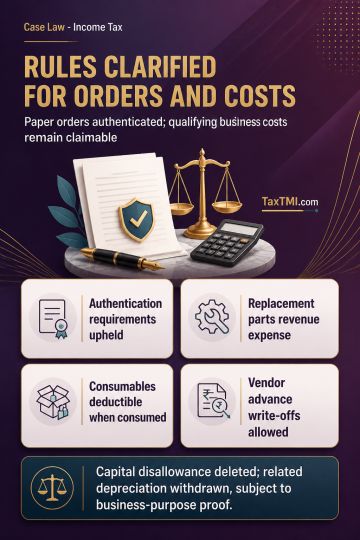
Authentication of paper assessment orders upheld, while qualifying repairs, consumables and vendor advance write-offs remain deductible business claim...
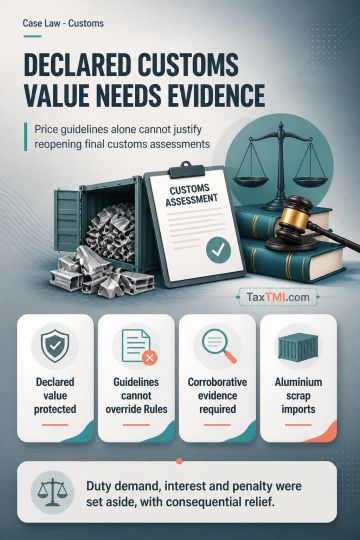
Transaction value cannot be rejected solely on non-statutory valuation guidelines without corroborative evidence supporting reassessment of final cust...
Cross-examination rights and corroborated evidence limit customs penalties for misdeclaration in genuine import transactions involving documented clea...
Tariff classification of vehicle gear components follows the specific gearing entry, displacing motor-vehicle parts classification and related liabili...
The Income Tax Appellate Tribunal held that the payments received by the assessee, a foreign resident without a permanent establishment in India, for providing offshore services vessels on hire were business receipts not taxable in India under the applicable Double Taxation Avoidance Agreement. The Tribunal rejected the tax authorities' reliance on Section 44BB of the Income Tax Act and the assessee's prior application for a lower withholding tax certificate, stating that the taxability of such receipts cannot be determined based solely on these factors. The Tribunal emphasized that the assessee's income cannot be taxed in India merely because it sought a lower withholding tax certificate, as determination of tax liability must be based on legal provisions, not unilateral concessions.
The Income Tax Appellate Tribunal held that the payments received by the assessee, a foreign resident without a permanent establishment in India, for providing offshore services vessels on hire were business receipts not taxable in India under the applicable Double Taxation Avoidance Agreement. The Tribunal rejected the tax authorities' reliance on Section 44BB of the Income Tax Act and the assessee's prior application for a lower withholding tax certificate, stating that the taxability of such receipts cannot be determined based solely on these factors. The Tribunal emphasized that the assessee's income cannot be taxed in India merely because it sought a lower withholding tax certificate, as determination of tax liability must be based on legal provisions, not unilateral concessions.
Note: It is a system-generated summary and is for quick reference only.
 TaxTMI
 of 4805










 Join Channel


 TaxTMI

