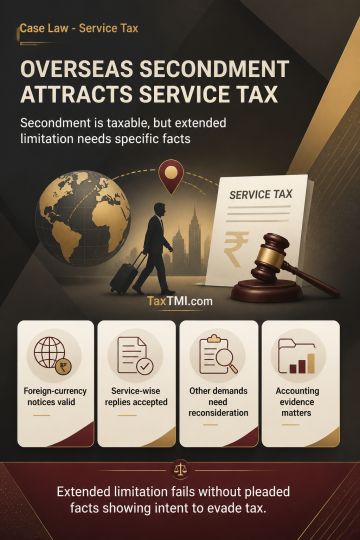
Extended limitation fails without specific suppression allegations, while overseas employee secondment remains taxable as manpower supply within norma...
Time-share accommodation classification excludes Club or Association Service where purchasers receive contractual occupancy rights without genuine mem...
CENVAT credit for trading requires reversal, while taxable-service rental credit remains proportionately available and limitation issues await resolut...
Vicarious liability for dishonoured company cheques may extend to non-signatory directors where complaints contain foundational responsibility avermen...
The Income Tax Appellate Tribunal held that the payments received by the assessee, a foreign resident without a permanent establishment in India, for providing offshore services vessels on hire were business receipts not taxable in India under the applicable Double Taxation Avoidance Agreement. The Tribunal rejected the tax authorities' reliance on Section 44BB of the Income Tax Act and the assessee's prior application for a lower withholding tax certificate, stating that the taxability of such receipts cannot be determined based solely on these factors. The Tribunal emphasized that the assessee's income cannot be taxed in India merely because it sought a lower withholding tax certificate, as determination of tax liability must be based on legal provisions, not unilateral concessions.
The Income Tax Appellate Tribunal held that the payments received by the assessee, a foreign resident without a permanent establishment in India, for providing offshore services vessels on hire were business receipts not taxable in India under the applicable Double Taxation Avoidance Agreement. The Tribunal rejected the tax authorities' reliance on Section 44BB of the Income Tax Act and the assessee's prior application for a lower withholding tax certificate, stating that the taxability of such receipts cannot be determined based solely on these factors. The Tribunal emphasized that the assessee's income cannot be taxed in India merely because it sought a lower withholding tax certificate, as determination of tax liability must be based on legal provisions, not unilateral concessions.
Note: It is a system-generated summary and is for quick reference only.
 TaxTMI
 of 4801








 Join Channel


 TaxTMI