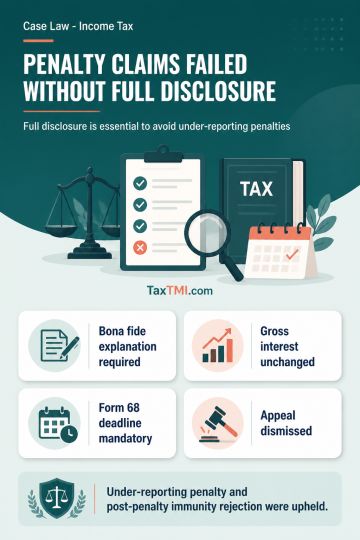
Bona fide disclosure requirements govern under-reporting penalties, and post-penalty immunity applications cannot secure available statutory protectio...
Certificate-of-origin verification procedure governs preferential customs benefits; denial without retroactive verification was set aside with consequ...
Disciplinary Committee jurisdiction and mandatory investigation requirements invalidated cancellation of an insolvency professional's registration and...
The assessee, a foreign-based company, initially failed to comply with the notice u/s 92D(3) within the statutory period of 60 days, responding on 25.03.2019 after a delay of 38 days. However, the Income Tax Appellate Tribunal (ITAT) considered the delay as minuscule and the reasons for non-compliance as bona fide and unintentional, given the peculiar circumstances of the assessee being a foreign entity and in the process of appointing a new authorized representative. The ITAT held that the penalty u/s 271G for non-compliance should be deleted, accepting the assessee's reasons for the inadvertent delay as reasonable. Consequently, the assessee's appeal against the penalty was allowed.
The assessee, a foreign-based company, initially failed to comply with the notice u/s 92D(3) within the statutory period of 60 days, responding on 25.03.2019 after a delay of 38 days. However, the Income Tax Appellate Tribunal (ITAT) considered the delay as minuscule and the reasons for non-compliance as bona fide and unintentional, given the peculiar circumstances of the assessee being a foreign entity and in the process of appointing a new authorized representative. The ITAT held that the penalty u/s 271G for non-compliance should be deleted, accepting the assessee's reasons for the inadvertent delay as reasonable. Consequently, the assessee's appeal against the penalty was allowed.
Note: It is a system-generated summary and is for quick reference only.
 TaxTMI
 of 4805



















 Join Channel


 TaxTMI
