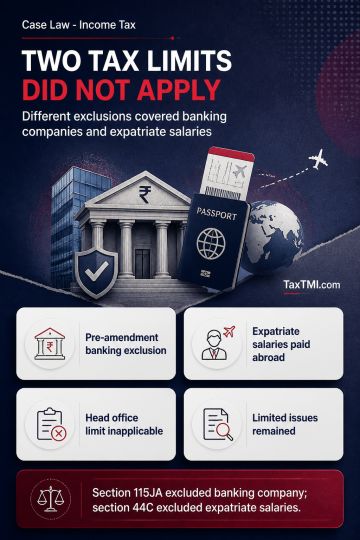
Minimum alternate tax exclusions for pre-amendment banking companies and expatriate Indian branch salaries remain outside head office expenditure limi...
Page of 4805
Press 'Enter' after typing page number.
1201 to 1220 of 96100 Results
❮
❯
❯❯
0 / 200
Expand Note
Add to Folder
No Folders have been created
+
Are you sure you want to delete "My most important" ?
The High Court held that the amendment introducing the words "or assessable" in Section 50C of the Income Tax Act, effective from October 1, 2009, cannot be applied retrospectively. Prior to the amendment, Section 50C was applicable only to transfers where the value was adopted or assessed by the stamp valuation authority. The inclusion of the phrase "or assessable" brought transfers where the value is assessable by the stamp valuation authority within the ambit of Section 50C. This introduction of a new class of transactions can only have prospective application and cannot be applied to transfers made before the amendment. Consequently, the assessee's transfer, which occurred before the amendment, cannot be subjected to Section 50C. The decision was in favor of the assessee.
The High Court held that the amendment introducing the words "or assessable" in Section 50C of the Income Tax Act, effective from October 1, 2009, cannot be applied retrospectively. Prior to the amendment, Section 50C was applicable only to transfers where the value was adopted or assessed by the stamp valuation authority. The inclusion of the phrase "or assessable" brought transfers where the value is assessable by the stamp valuation authority within the ambit of Section 50C. This introduction of a new class of transactions can only have prospective application and cannot be applied to transfers made before the amendment. Consequently, the assessee's transfer, which occurred before the amendment, cannot be subjected to Section 50C. The decision was in favor of the assessee.
Note: It is a system-generated summary and is for quick reference only.
 TaxTMI
 of 4805






 Join Channel


 TaxTMI