Opportunity to respond to jurisdictional reports is mandatory before customs settlement duty enhancement; connected applications require consistent ad...
Specific customs headings for scaffolding components prevail over general classification, invalidating misclassification proceedings and enabling with...
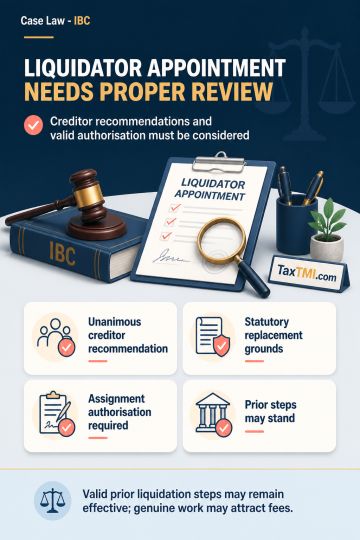
Liquidator appointment under Section 34 requires consideration of creditor recommendations, valid professional authorisation, and preservation of vali...
Income-tax exemption for specified regulatory fees and government grants applies subject to non-commercial activity and continuing compliance conditio...
Digital accessibility audit and remediation deadlines extended, while all other disability-compliance obligations for regulated entities remain unchan...
Page of 4803
Press 'Enter' after typing page number.
621 to 640 of 96047 Results
❮
❯
❯❯
0 / 200
Expand Note
Add to Folder
No Folders have been created
+
Are you sure you want to delete "My most important" ?
The Company Tribunal held that Respondent No. 1 company is not a quasi-partnership due to lack of equality in shareholding since 1997 and failure to establish grounds for winding up. The alleged family settlement of 1986 was not proved. The rights issue reducing petitioners' shareholding from 15% to 7.5% was not challenged earlier, hence cannot be grounds for oppression now. Non-payment of gratuity to Petitioner No. 1 and non-appointment of Petitioner No. 2 as director cannot constitute oppression. The petition was partly allowed, directing Respondents No. 1 to 5 to buy out petitioners' shares at fair value determined by an independent valuer.
The Company Tribunal held that Respondent No. 1 company is not a quasi-partnership due to lack of equality in shareholding since 1997 and failure to establish grounds for winding up. The alleged family settlement of 1986 was not proved. The rights issue reducing petitioners' shareholding from 15% to 7.5% was not challenged earlier, hence cannot be grounds for oppression now. Non-payment of gratuity to Petitioner No. 1 and non-appointment of Petitioner No. 2 as director cannot constitute oppression. The petition was partly allowed, directing Respondents No. 1 to 5 to buy out petitioners' shares at fair value determined by an independent valuer.
Note: It is a system-generated summary and is for quick reference only.
 TaxTMI
 of 4803













 Join Channel


 TaxTMI