Capital-goods exemption covers plant-modernisation accessories, while the import restriction applies only to earlier capital-goods components and spar...
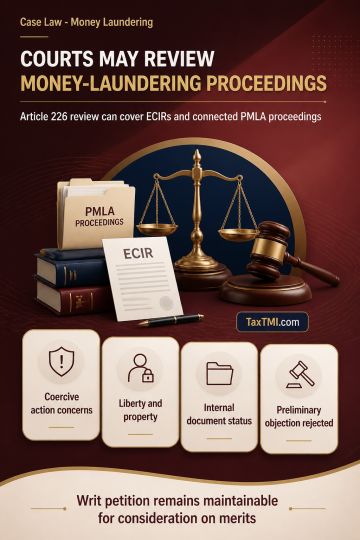
Constitutional judicial review permits challenges to ECIRs and connected money-laundering proceedings where coercive action affects fundamental intere...
The Company Tribunal held that Respondent No. 1 company is not a quasi-partnership due to lack of equality in shareholding since 1997 and failure to establish grounds for winding up. The alleged family settlement of 1986 was not proved. The rights issue reducing petitioners' shareholding from 15% to 7.5% was not challenged earlier, hence cannot be grounds for oppression now. Non-payment of gratuity to Petitioner No. 1 and non-appointment of Petitioner No. 2 as director cannot constitute oppression. The petition was partly allowed, directing Respondents No. 1 to 5 to buy out petitioners' shares at fair value determined by an independent valuer.
The Company Tribunal held that Respondent No. 1 company is not a quasi-partnership due to lack of equality in shareholding since 1997 and failure to establish grounds for winding up. The alleged family settlement of 1986 was not proved. The rights issue reducing petitioners' shareholding from 15% to 7.5% was not challenged earlier, hence cannot be grounds for oppression now. Non-payment of gratuity to Petitioner No. 1 and non-appointment of Petitioner No. 2 as director cannot constitute oppression. The petition was partly allowed, directing Respondents No. 1 to 5 to buy out petitioners' shares at fair value determined by an independent valuer.
Note: It is a system-generated summary and is for quick reference only.
 TaxTMI
 of 4803






 Join Channel


 TaxTMI