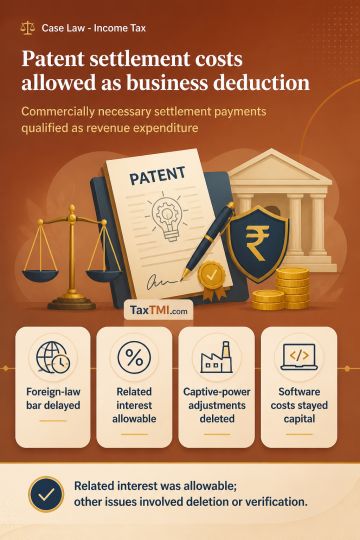
Patent-settlement expenditure treated as commercially expedient revenue outlay, with foreign-law restrictions inapplicable before the prospective amen...
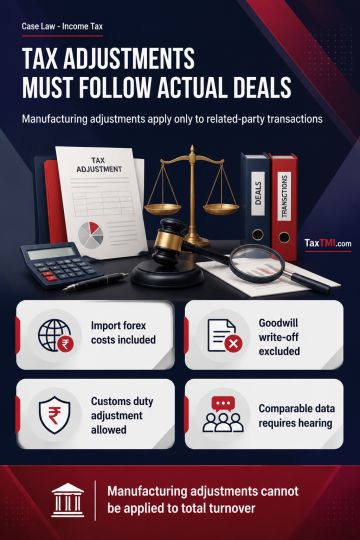
International transaction benchmarking restricts transfer pricing adjustments to associated-enterprise dealings, while functional comparability govern...
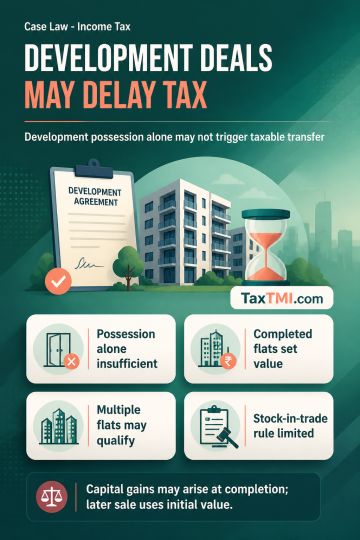
Joint development agreements defer taxable transfer where possession lacks part performance, while completed flats determine consideration and exempti...
Passenger baggage re-export requires true declaration and cannot be granted indirectly through discretionary redemption of undeclared prohibited goods...
Page of 4803
Press 'Enter' after typing page number.
501 to 520 of 96046 Results
❮
❯
❯❯
0 / 200
Expand Note
Add to Folder
No Folders have been created
+
Are you sure you want to delete "My most important" ?
The appellant received services classifiable as online information and database access or retrieval (OIDAR) services from outside India. As the recipient of such services, the appellant was held liable to pay service tax u/ss 66A and 68 of the Finance Act, 1994, read with Rule 2(1)(d)(iv) of the Service Tax Rules, 1994, for the period from October 1, 2006, to March 2008, along with interest u/s 75 of the Act. The demand for service tax and interest was upheld. However, the penalties imposed u/ss 76 and 77 of the Act were set aside, as there was no suppression of facts, and the demand arose due to interpretation of legal provisions. The appeals were partially allowed to the extent of setting aside the penalties.
The appellant received services classifiable as online information and database access or retrieval (OIDAR) services from outside India. As the recipient of such services, the appellant was held liable to pay service tax u/ss 66A and 68 of the Finance Act, 1994, read with Rule 2(1)(d)(iv) of the Service Tax Rules, 1994, for the period from October 1, 2006, to March 2008, along with interest u/s 75 of the Act. The demand for service tax and interest was upheld. However, the penalties imposed u/ss 76 and 77 of the Act were set aside, as there was no suppression of facts, and the demand arose due to interpretation of legal provisions. The appeals were partially allowed to the extent of setting aside the penalties.
Note: It is a system-generated summary and is for quick reference only.
 TaxTMI
 of 4803











 Join Channel


 TaxTMI