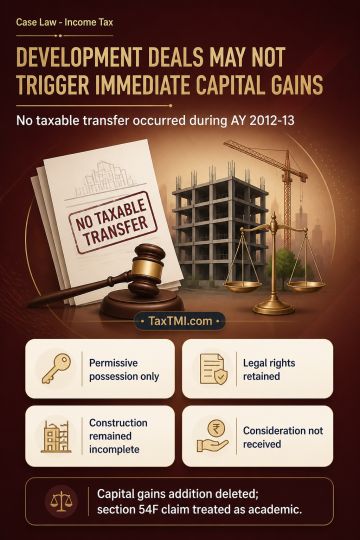
Development agreements require legal possession or effective enjoyment for capital gains transfer; permissive possession and deferred consideration de...
Prolonged sterilisation of development rights supports capital-gains treatment, while business-income disallowances cannot govern capital-gains comput...
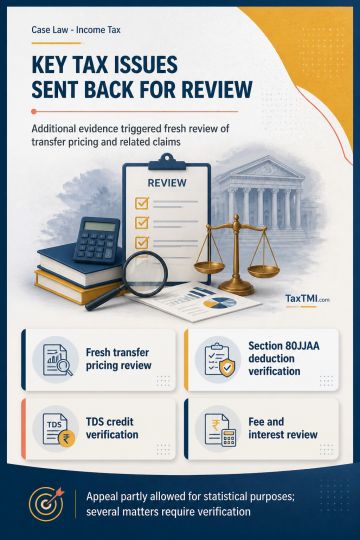
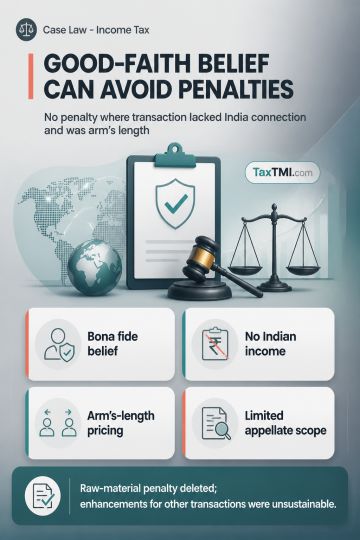
Additional evidence in transfer pricing dispute leads to fresh examination, while tax deductions, TDS credit, fee and refund interest require verifica...
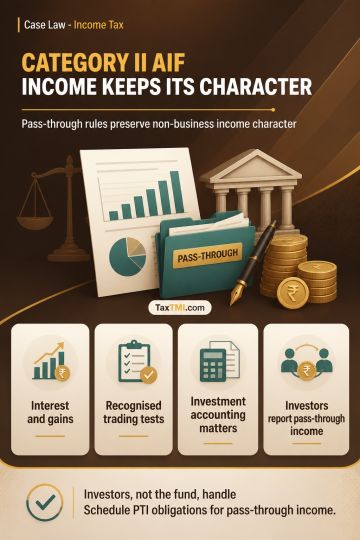
Category II AIF pass-through taxation preserves non-business income character; investment receipts cannot be reclassified without applying recognised ...
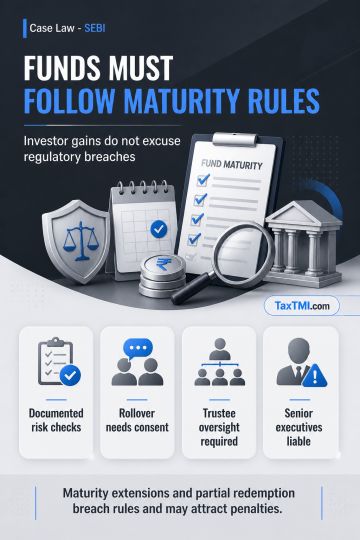
Mutual fund maturity rules require proper rollover, redemption, disclosure, and due diligence; investor gains cannot excuse regulatory breaches or pen...
The appellants were held eligible for refund of Cenvat credit u/s 142(3) of the CGST Act, 2017. The Tribunal ruled that Section 142(8)(a) was wrongly invoked to reject the refund claim, as it pertains only to input tax credit and not Cenvat credit for the pre-GST period. Payment u/s 73(3) of the Finance Act, 1994 did not impact admissibility of the Cenvat credit. Rule 9(1)(bb) of the Cenvat Credit Rules, 2004 was inapplicable in this reverse charge scenario without any show cause notice or adjudication order. Consequently, the impugned order was set aside, and the appeal was allowed.
The appellants were held eligible for refund of Cenvat credit u/s 142(3) of the CGST Act, 2017. The Tribunal ruled that Section 142(8)(a) was wrongly invoked to reject the refund claim, as it pertains only to input tax credit and not Cenvat credit for the pre-GST period. Payment u/s 73(3) of the Finance Act, 1994 did not impact admissibility of the Cenvat credit. Rule 9(1)(bb) of the Cenvat Credit Rules, 2004 was inapplicable in this reverse charge scenario without any show cause notice or adjudication order. Consequently, the impugned order was set aside, and the appeal was allowed.
Note: It is a system-generated summary and is for quick reference only.
 TaxTMI
  TaxTMI
 of 4809








 Join Channel