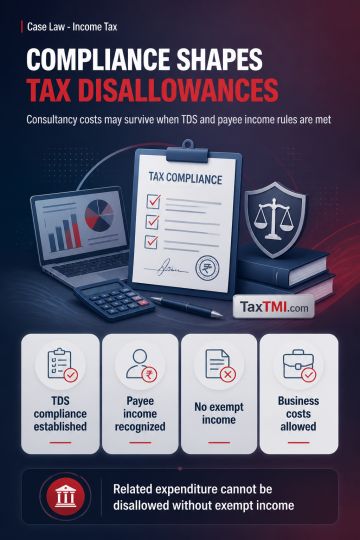
Tax deduction compliance and payee income recognition govern consultancy disallowance, while no exempt income prevents related expenditure disallowanc...
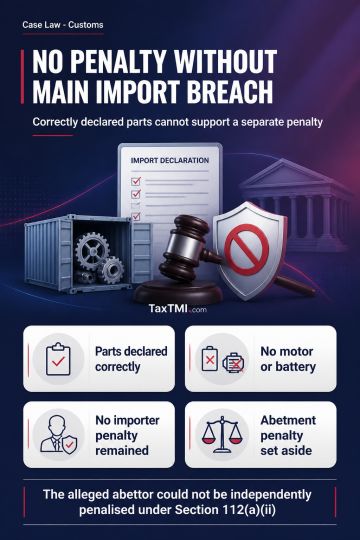
Derivative abetment liability fails when correctly declared imported components establish no underlying improper importation by the principal importer...
Page of 4805
Press 'Enter' after typing page number.
701 to 720 of 96100 Results
❮
❯
❯❯
0 / 200
Expand Note
Add to Folder
No Folders have been created
+
Are you sure you want to delete "My most important" ?
The appellants were held eligible for refund of Cenvat credit u/s 142(3) of the CGST Act, 2017. The Tribunal ruled that Section 142(8)(a) was wrongly invoked to reject the refund claim, as it pertains only to input tax credit and not Cenvat credit for the pre-GST period. Payment u/s 73(3) of the Finance Act, 1994 did not impact admissibility of the Cenvat credit. Rule 9(1)(bb) of the Cenvat Credit Rules, 2004 was inapplicable in this reverse charge scenario without any show cause notice or adjudication order. Consequently, the impugned order was set aside, and the appeal was allowed.
The appellants were held eligible for refund of Cenvat credit u/s 142(3) of the CGST Act, 2017. The Tribunal ruled that Section 142(8)(a) was wrongly invoked to reject the refund claim, as it pertains only to input tax credit and not Cenvat credit for the pre-GST period. Payment u/s 73(3) of the Finance Act, 1994 did not impact admissibility of the Cenvat credit. Rule 9(1)(bb) of the Cenvat Credit Rules, 2004 was inapplicable in this reverse charge scenario without any show cause notice or adjudication order. Consequently, the impugned order was set aside, and the appeal was allowed.
Note: It is a system-generated summary and is for quick reference only.
 TaxTMI
 of 4805











 Join Channel


 TaxTMI