Specialized Investment Fund distribution now requires dedicated certification, while transitional recognition preserves existing qualified distributor...
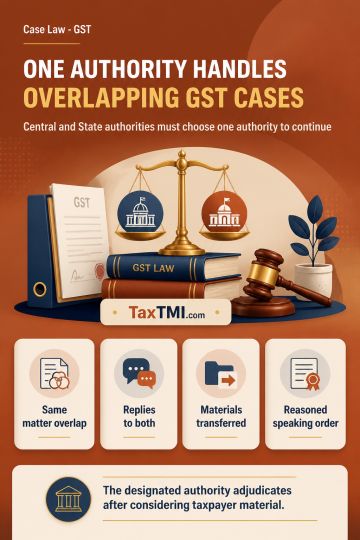
Overlapping GST proceedings require Central and State authorities to designate one competent authority for coordinated adjudication of the same matter...
Composite healthcare supplies retain exemption when patient care is the contract's essential character, despite payment through an implementing agency...
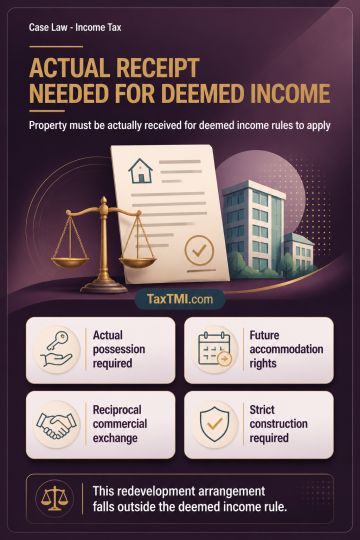
Receipt of immovable property requires actual possession or enjoyment; redevelopment allotments exchanged for tenancy rights fall outside deemed incom...
Page of 4828
Press 'Enter' after typing page number.
1481 to 1500 of 96556 Results
❮
❯
❯❯
0 / 200
Expand Note
Add to Folder
No Folders have been created
+
Are you sure you want to delete "My most important" ?
The ITAT ruled in favor of the assessee, allowing the loss incurred in stock option transactions. The Assessing Officer (AO) had disallowed the loss, alleging that the options were sold at unreasonably low prices, even below their intrinsic value. However, the ITAT observed that the AO's conclusion was based solely on conjecture without any corroborative evidence. The assessee had provided contract notes and ledger accounts proving the transactions were conducted through the Bombay Stock Exchange (BSE). Despite this, the revenue authorities neither rebutted nor challenged the authenticity of the submitted documents. The assessee discharged their burden of proof, and the onus shifted to the revenue authorities, who failed to bring any comparative data or evidence to substantiate their claims. Consequently, the ITAT set aside the impugned appellate order and deleted the addition, deciding in favor of the assessee.
The ITAT ruled in favor of the assessee, allowing the loss incurred in stock option transactions. The Assessing Officer (AO) had disallowed the loss, alleging that the options were sold at unreasonably low prices, even below their intrinsic value. However, the ITAT observed that the AO's conclusion was based solely on conjecture without any corroborative evidence. The assessee had provided contract notes and ledger accounts proving the transactions were conducted through the Bombay Stock Exchange (BSE). Despite this, the revenue authorities neither rebutted nor challenged the authenticity of the submitted documents. The assessee discharged their burden of proof, and the onus shifted to the revenue authorities, who failed to bring any comparative data or evidence to substantiate their claims. Consequently, the ITAT set aside the impugned appellate order and deleted the addition, deciding in favor of the assessee.
Note: It is a system-generated summary and is for quick reference only.
 TaxTMI
  TaxTMI
 of 4828












 Join Channel