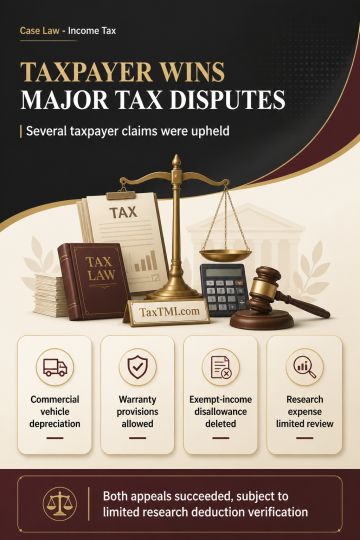
Commercial vehicle depreciation, scientifically determined warranty provisions and exempt-income disallowances were resolved in favour of the taxpayer...
Inherited property sale proceeds require capital-gains treatment where ownership is supported by evidence, not suspicion or unverified signature doubt...
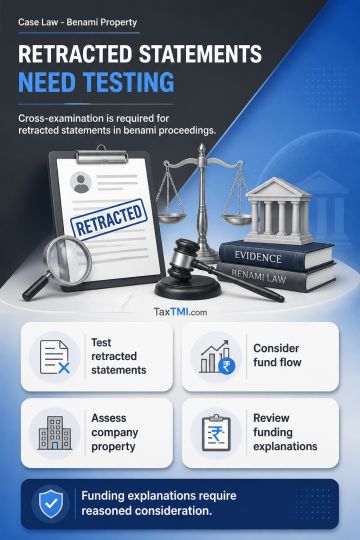
Cross-examination of retracted statements is essential where foundational evidence supports a benami allegation and documented funding explanations re...
Capital-goods exemption covers plant-modernisation accessories, while the import restriction applies only to earlier capital-goods components and spar...
Page of 4819
Press 'Enter' after typing page number.
781 to 800 of 96365 Results
❮
❯
❯❯
0 / 200
Expand Note
Add to Folder
No Folders have been created
+
Are you sure you want to delete "My most important" ?
The ITAT ruled in favor of the assessee, allowing the loss incurred in stock option transactions. The Assessing Officer (AO) had disallowed the loss, alleging that the options were sold at unreasonably low prices, even below their intrinsic value. However, the ITAT observed that the AO's conclusion was based solely on conjecture without any corroborative evidence. The assessee had provided contract notes and ledger accounts proving the transactions were conducted through the Bombay Stock Exchange (BSE). Despite this, the revenue authorities neither rebutted nor challenged the authenticity of the submitted documents. The assessee discharged their burden of proof, and the onus shifted to the revenue authorities, who failed to bring any comparative data or evidence to substantiate their claims. Consequently, the ITAT set aside the impugned appellate order and deleted the addition, deciding in favor of the assessee.
The ITAT ruled in favor of the assessee, allowing the loss incurred in stock option transactions. The Assessing Officer (AO) had disallowed the loss, alleging that the options were sold at unreasonably low prices, even below their intrinsic value. However, the ITAT observed that the AO's conclusion was based solely on conjecture without any corroborative evidence. The assessee had provided contract notes and ledger accounts proving the transactions were conducted through the Bombay Stock Exchange (BSE). Despite this, the revenue authorities neither rebutted nor challenged the authenticity of the submitted documents. The assessee discharged their burden of proof, and the onus shifted to the revenue authorities, who failed to bring any comparative data or evidence to substantiate their claims. Consequently, the ITAT set aside the impugned appellate order and deleted the addition, deciding in favor of the assessee.
Note: It is a system-generated summary and is for quick reference only.
 TaxTMI
  TaxTMI
 of 4819







 Join Channel