Food supplement classification requires common parlance and authoritative tests, preventing treatment as proprietary Ayurvedic medicines without suppo...
Specified regulatory authority income receives conditional tax exemption, subject to non-commercial activity, unchanged income character, and return f...
Tax exemption for regulatory authority income applies retrospectively, subject to non-commercial activity, unchanged income sources, and return-filing...
Input tax credit conditions remain constitutionally valid, with eligible recipient claims considered under GST circulars and retrospective filing dead...
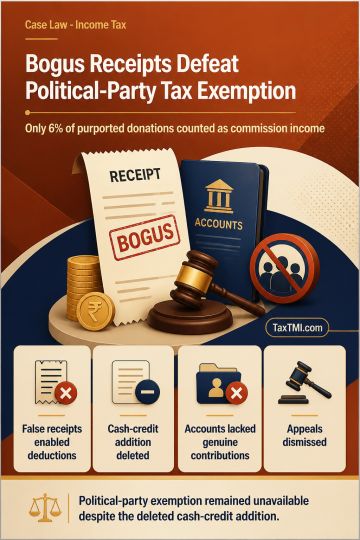
Bogus donation receipts justified commission income assessment and defeated political-party tax exemption for inaccurate accounts and reporting failur...
Page of 4821
Press 'Enter' after typing page number.
1101 to 1120 of 96408 Results
❮
❯
❯❯
0 / 200
Expand Note
Add to Folder
No Folders have been created
+
Are you sure you want to delete "My most important" ?
The CESTAT allowed the appeal in part by modifying the impugned order. It set aside the revocation of the Customs Broker's license and forfeiture of security deposit, as there was no violation of Regulations 1(4), 10(d), 10(n), and 13(12) of the Customs Brokers Licensing Regulations (CBLR), 2018. However, a penalty of Rs. 5,000 was imposed on the Customs Broker for violating Regulation 10(e) due to failure to exercise due diligence in handling documents while filing import declarations. The Tribunal held that the Customs Broker cannot be faulted for misdeclaration by the importer, as they filed the bill of entry based on documents provided. The delay in inquiry proceedings was not properly explained, and the entire blame cannot be placed on the Customs Broker.
The CESTAT allowed the appeal in part by modifying the impugned order. It set aside the revocation of the Customs Broker's license and forfeiture of security deposit, as there was no violation of Regulations 1(4), 10(d), 10(n), and 13(12) of the Customs Brokers Licensing Regulations (CBLR), 2018. However, a penalty of Rs. 5,000 was imposed on the Customs Broker for violating Regulation 10(e) due to failure to exercise due diligence in handling documents while filing import declarations. The Tribunal held that the Customs Broker cannot be faulted for misdeclaration by the importer, as they filed the bill of entry based on documents provided. The delay in inquiry proceedings was not properly explained, and the entire blame cannot be placed on the Customs Broker.
Note: It is a system-generated summary and is for quick reference only.
 TaxTMI
  TaxTMI
 of 4821


















 Join Channel