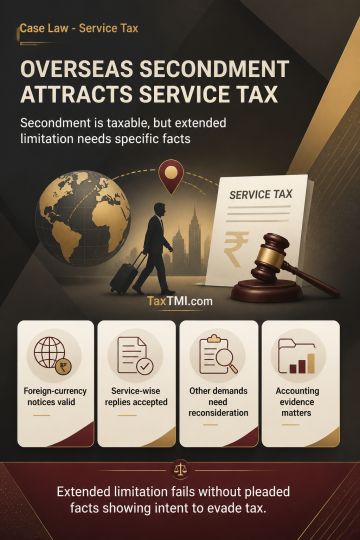
Extended limitation fails without specific suppression allegations, while overseas employee secondment remains taxable as manpower supply within norma...
Time-share accommodation classification excludes Club or Association Service where purchasers receive contractual occupancy rights without genuine mem...
CENVAT credit for trading requires reversal, while taxable-service rental credit remains proportionately available and limitation issues await resolut...
Vicarious liability for dishonoured company cheques may extend to non-signatory directors where complaints contain foundational responsibility avermen...
The CESTAT held that Section 28AAA of the Customs Act, 1962, invoked by the Revenue for recovery of duty foregone, requires establishing collusion, willful misrepresentation or suppression of facts at the time of obtaining the instrument for exemption. Mere non-repatriation of export proceeds does not automatically erase eligibility for exemption. The Tribunal found no evidence of the required ingredients u/s 28AAA to justify recovery of duty foregone or cancellation of bank realization certificates. The alleged mis-declaration of goods did not warrant confiscation u/s 113(d) as the goods were not prohibited for export. The demands for recovery of drawback, duty foregone, and confiscation of goods were quashed. Penalties imposed on individuals were also set aside due to lack of sustainable grounds. The Tribunal dismissed the Revenue's appeals and allowed the appeals of exporters and individuals.
The CESTAT held that Section 28AAA of the Customs Act, 1962, invoked by the Revenue for recovery of duty foregone, requires establishing collusion, willful misrepresentation or suppression of facts at the time of obtaining the instrument for exemption. Mere non-repatriation of export proceeds does not automatically erase eligibility for exemption. The Tribunal found no evidence of the required ingredients u/s 28AAA to justify recovery of duty foregone or cancellation of bank realization certificates. The alleged mis-declaration of goods did not warrant confiscation u/s 113(d) as the goods were not prohibited for export. The demands for recovery of drawback, duty foregone, and confiscation of goods were quashed. Penalties imposed on individuals were also set aside due to lack of sustainable grounds. The Tribunal dismissed the Revenue's appeals and allowed the appeals of exporters and individuals.
Note: It is a system-generated summary and is for quick reference only.
 TaxTMI
  TaxTMI
 of 4819








 Join Channel


