Specialized Investment Fund distribution now requires dedicated certification, while transitional recognition preserves existing qualified distributor...
Overlapping GST proceedings require Central and State authorities to designate one competent authority for coordinated adjudication of the same matter...
Composite healthcare supplies retain exemption when patient care is the contract's essential character, despite payment through an implementing agency...
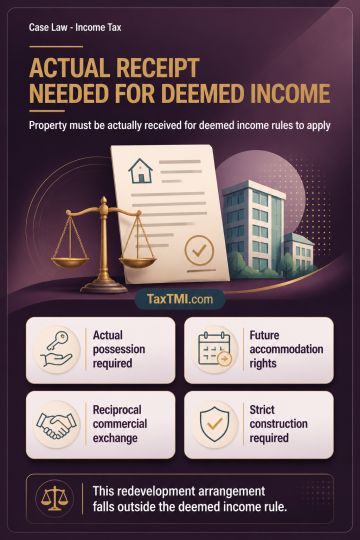
Receipt of immovable property requires actual possession or enjoyment; redevelopment allotments exchanged for tenancy rights fall outside deemed incom...
Page of 4828
Press 'Enter' after typing page number.
1481 to 1500 of 96556 Results
❮
❯
❯❯
0 / 200
Expand Note
Add to Folder
No Folders have been created
+
Are you sure you want to delete "My most important" ?
The High Court dismissed the petition challenging the show cause notice issued by SEBI. The key findings were: the arguments of delay, laches, review, revisit, double jeopardy, and res judicata were not accepted to quash the notice at this stage, allowing petitioners to raise such defenses before SEBI. The Court found no non-application of mind by SEBI in issuing the notice based on the available material. SEBI agreed to provide certain information related to an earlier complaint within two weeks. Petitioners were granted four weeks after receiving that information to file their response to the show cause notice. The Court declined to interfere further, stating that fairness is a two-way process, and prolonging adjudication unnecessarily should be avoided. The extraordinary jurisdiction was not meant for stalling proceedings at every stage.
The High Court dismissed the petition challenging the show cause notice issued by SEBI. The key findings were: the arguments of delay, laches, review, revisit, double jeopardy, and res judicata were not accepted to quash the notice at this stage, allowing petitioners to raise such defenses before SEBI. The Court found no non-application of mind by SEBI in issuing the notice based on the available material. SEBI agreed to provide certain information related to an earlier complaint within two weeks. Petitioners were granted four weeks after receiving that information to file their response to the show cause notice. The Court declined to interfere further, stating that fairness is a two-way process, and prolonging adjudication unnecessarily should be avoided. The extraordinary jurisdiction was not meant for stalling proceedings at every stage.
Note: It is a system-generated summary and is for quick reference only.
 TaxTMI
  TaxTMI
 of 4828
















 Join Channel