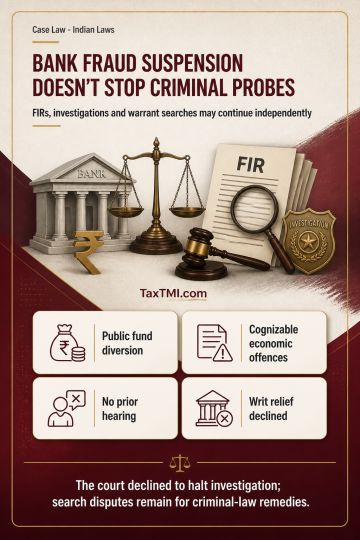
Administrative fraud classification suspension does not halt independent criminal investigation or warrant-based searches into alleged economic offenc...
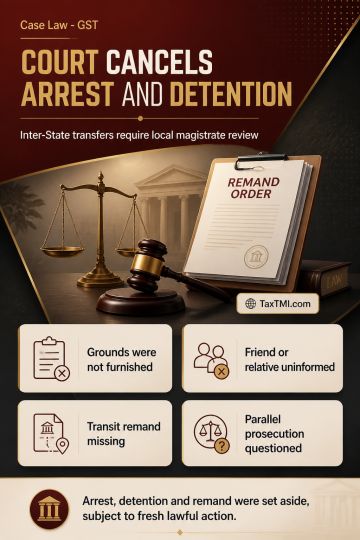
Arrest safeguards and transit remand requirements invalidated detention following inter-State transfer without communicated grounds or magistrate auth...
Arrest safeguards require disclosed grounds, relative intimation and transit remand, while duplicate prosecution under the CGST framework is unsustain...
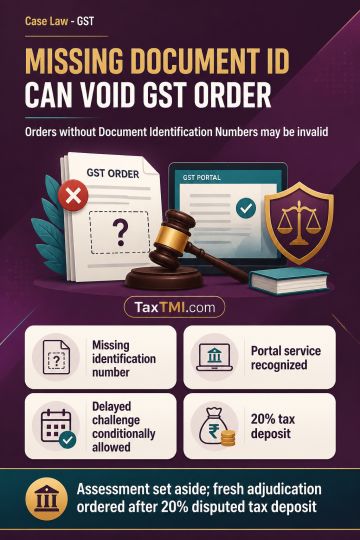
Document Identification Number defects can invalidate GST assessments, with delayed challenges entertained conditionally where patent irregularities e...
Page of 4826
Press 'Enter' after typing page number.
1241 to 1260 of 96510 Results
❮
❯
❯❯
0 / 200
Expand Note
Add to Folder
No Folders have been created
+
Are you sure you want to delete "My most important" ?
The High Court dismissed the petition challenging the show cause notice issued by SEBI. The key findings were: the arguments of delay, laches, review, revisit, double jeopardy, and res judicata were not accepted to quash the notice at this stage, allowing petitioners to raise such defenses before SEBI. The Court found no non-application of mind by SEBI in issuing the notice based on the available material. SEBI agreed to provide certain information related to an earlier complaint within two weeks. Petitioners were granted four weeks after receiving that information to file their response to the show cause notice. The Court declined to interfere further, stating that fairness is a two-way process, and prolonging adjudication unnecessarily should be avoided. The extraordinary jurisdiction was not meant for stalling proceedings at every stage.
The High Court dismissed the petition challenging the show cause notice issued by SEBI. The key findings were: the arguments of delay, laches, review, revisit, double jeopardy, and res judicata were not accepted to quash the notice at this stage, allowing petitioners to raise such defenses before SEBI. The Court found no non-application of mind by SEBI in issuing the notice based on the available material. SEBI agreed to provide certain information related to an earlier complaint within two weeks. Petitioners were granted four weeks after receiving that information to file their response to the show cause notice. The Court declined to interfere further, stating that fairness is a two-way process, and prolonging adjudication unnecessarily should be avoided. The extraordinary jurisdiction was not meant for stalling proceedings at every stage.
Note: It is a system-generated summary and is for quick reference only.
 TaxTMI
  TaxTMI
 of 4826









 Join Channel