Opportunity to respond to jurisdictional reports is mandatory before customs settlement duty enhancement; connected applications require consistent ad...
Specific customs headings for scaffolding components prevail over general classification, invalidating misclassification proceedings and enabling with...
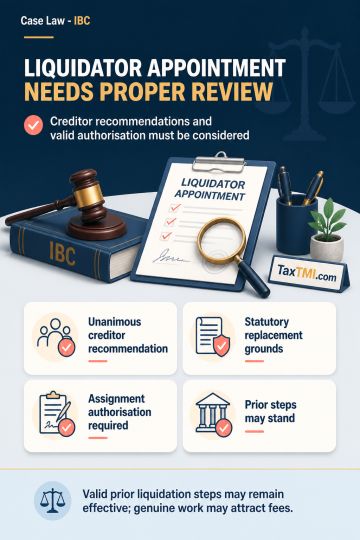
Liquidator appointment under Section 34 requires consideration of creditor recommendations, valid professional authorisation, and preservation of vali...
Income-tax exemption for specified regulatory fees and government grants applies subject to non-commercial activity and continuing compliance conditio...
Page of 4821
Press 'Enter' after typing page number.
981 to 1000 of 96408 Results
❮
❯
❯❯
0 / 200
Expand Note
Add to Folder
No Folders have been created
+
Are you sure you want to delete "My most important" ?
The Appellate Tribunal held that the extended period of limitation for demand of duty could not be invoked as there was no suppression of facts or intent to evade payment of Central Excise duty by the appellants. The manufacture, clearances, and business transactions were duly recorded in books of account maintained by the appellants. The CENVAT credit demand and interest were set aside as the credit was reversed without utilization. No penalty was imposable as there was no intention to evade duty. The personal penalty on the partner was also set aside, following jurisdictional High Court precedents that separate personal penalties on partners in a firm case are unjustified. Consequently, the appeal was allowed.
The Appellate Tribunal held that the extended period of limitation for demand of duty could not be invoked as there was no suppression of facts or intent to evade payment of Central Excise duty by the appellants. The manufacture, clearances, and business transactions were duly recorded in books of account maintained by the appellants. The CENVAT credit demand and interest were set aside as the credit was reversed without utilization. No penalty was imposable as there was no intention to evade duty. The personal penalty on the partner was also set aside, following jurisdictional High Court precedents that separate personal penalties on partners in a firm case are unjustified. Consequently, the appeal was allowed.
Note: It is a system-generated summary and is for quick reference only.
 TaxTMI
  TaxTMI
 of 4821













 Join Channel


