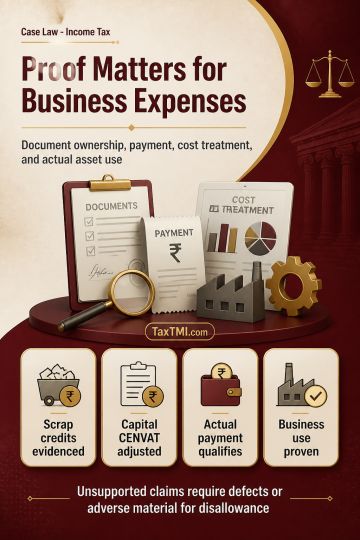
Business expenditure substantiation supports scrap credits, statutory payments and expense claims, while depreciation requires proof of actual busines...
Captive power transfer pricing and non-resident export commission rules support deletion of adjustments and withholding disallowance in discussed proc...
Page of 4828
Press 'Enter' after typing page number.
1321 to 1340 of 96556 Results
❮
❯
❯❯
0 / 200
Expand Note
Add to Folder
No Folders have been created
+
Are you sure you want to delete "My most important" ?
The petitioner-accused and the complainant-respondent settled the matter related to dishonor of cheque. The High Court accepted the prayer for compounding the offence u/s 147 of the Negotiable Instruments Act, 1881, following the Supreme Court's guidelines in Damodar S. Prabhu v. Sayed Babalal H. Noting the non-obstante clause in Section 147, the Court held that compounding is controlled by this provision, not Section 320 of CrPC. Relying on K. Subramanian v. R. Rajathi, the Court allowed compounding even after conviction. Consequently, the conviction and sentence were quashed, and the petitioner-accused was acquitted u/s 138 of the Act.
The petitioner-accused and the complainant-respondent settled the matter related to dishonor of cheque. The High Court accepted the prayer for compounding the offence u/s 147 of the Negotiable Instruments Act, 1881, following the Supreme Court's guidelines in Damodar S. Prabhu v. Sayed Babalal H. Noting the non-obstante clause in Section 147, the Court held that compounding is controlled by this provision, not Section 320 of CrPC. Relying on K. Subramanian v. R. Rajathi, the Court allowed compounding even after conviction. Consequently, the conviction and sentence were quashed, and the petitioner-accused was acquitted u/s 138 of the Act.
Note: It is a system-generated summary and is for quick reference only.
 TaxTMI
  TaxTMI
 of 4828









 Join Channel