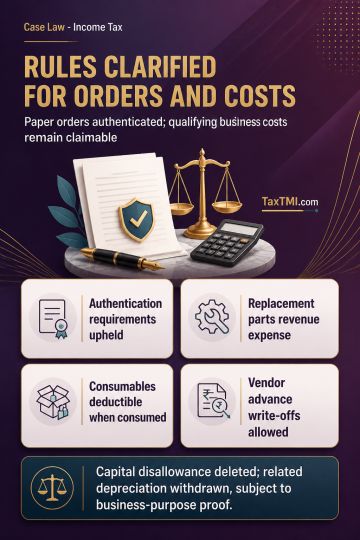
Authentication of paper assessment orders upheld, while qualifying repairs, consumables and vendor advance write-offs remain deductible business claim...
Transaction value cannot be rejected solely on non-statutory valuation guidelines without corroborative evidence supporting reassessment of final cust...
Cross-examination rights and corroborated evidence limit customs penalties for misdeclaration in genuine import transactions involving documented clea...
Page of 4827
Press 'Enter' after typing page number.
1201 to 1220 of 96536 Results
❮
❯
❯❯
0 / 200
Expand Note
Add to Folder
No Folders have been created
+
Are you sure you want to delete "My most important" ?
The petitioner-accused and the complainant-respondent settled the matter related to dishonor of cheque. The High Court accepted the prayer for compounding the offence u/s 147 of the Negotiable Instruments Act, 1881, following the Supreme Court's guidelines in Damodar S. Prabhu v. Sayed Babalal H. Noting the non-obstante clause in Section 147, the Court held that compounding is controlled by this provision, not Section 320 of CrPC. Relying on K. Subramanian v. R. Rajathi, the Court allowed compounding even after conviction. Consequently, the conviction and sentence were quashed, and the petitioner-accused was acquitted u/s 138 of the Act.
The petitioner-accused and the complainant-respondent settled the matter related to dishonor of cheque. The High Court accepted the prayer for compounding the offence u/s 147 of the Negotiable Instruments Act, 1881, following the Supreme Court's guidelines in Damodar S. Prabhu v. Sayed Babalal H. Noting the non-obstante clause in Section 147, the Court held that compounding is controlled by this provision, not Section 320 of CrPC. Relying on K. Subramanian v. R. Rajathi, the Court allowed compounding even after conviction. Consequently, the conviction and sentence were quashed, and the petitioner-accused was acquitted u/s 138 of the Act.
Note: It is a system-generated summary and is for quick reference only.
 TaxTMI
  TaxTMI
 of 4827












 Join Channel




