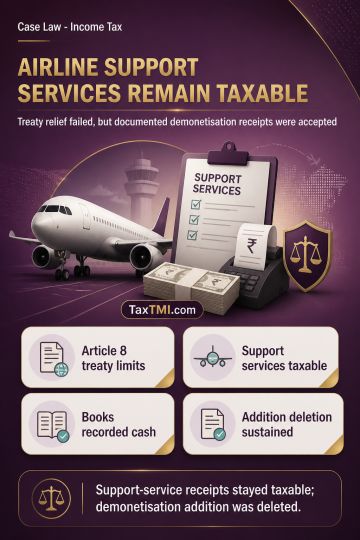
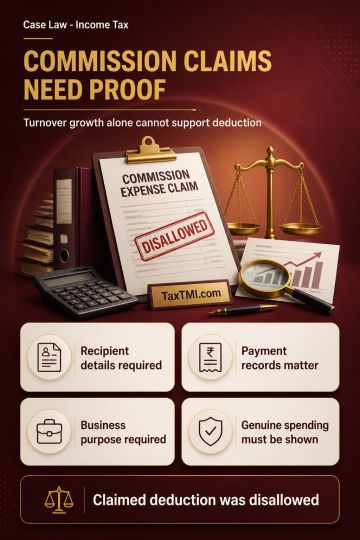
Business expenditure deduction requires proof of genuine commission payments and commercial allowability; turnover growth alone cannot validate the cl...
Article 8 treaty coverage excluded third-party airline support services, while documented demonetisation cash receipts remained accepted business inco...
Page of 4778
Press 'Enter' after typing page number.
81 to 100 of 95557 Results
❮
❯
❯❯
0 / 200
Expand Note
Add to Folder
No Folders have been created
+
Are you sure you want to delete "My most important" ?
The National Company Law Appellate Tribunal (NCLAT) dismissed the appeal, upholding the order admitting the Section 7 application filed by ICICI Bank against the Corporate Debtor for initiating the Corporate Insolvency Resolution Process (CIRP). The key findings were: The direction issued by the Reserve Bank of India (RBI) to ICICI Bank to initiate CIRP against the Corporate Debtor is relevant for determining default u/s 3(12) of the Insolvency and Bankruptcy Code (IBC). The scheme of arrangement to transfer the debt under Bucket 2B to a Special Purpose Vehicle was not approved, leading to default by the Corporate Debtor in servicing the debt. The Master Restructuring Agreement did not cover the facilities for which the Section 7 application was filed. The Corporate Debtor's One-Time Settlement proposal acknowledged the debt and default. The Financial Creditor brought sufficient material on record to prove debt and default by the Corporate Debtor.
The National Company Law Appellate Tribunal (NCLAT) dismissed the appeal, upholding the order admitting the Section 7 application filed by ICICI Bank against the Corporate Debtor for initiating the Corporate Insolvency Resolution Process (CIRP). The key findings were: The direction issued by the Reserve Bank of India (RBI) to ICICI Bank to initiate CIRP against the Corporate Debtor is relevant for determining default u/s 3(12) of the Insolvency and Bankruptcy Code (IBC). The scheme of arrangement to transfer the debt under Bucket 2B to a Special Purpose Vehicle was not approved, leading to default by the Corporate Debtor in servicing the debt. The Master Restructuring Agreement did not cover the facilities for which the Section 7 application was filed. The Corporate Debtor's One-Time Settlement proposal acknowledged the debt and default. The Financial Creditor brought sufficient material on record to prove debt and default by the Corporate Debtor.
Note: It is a system-generated summary and is for quick reference only.
 TaxTMI
 of 4778



 Join Channel


 TaxTMI