Fair-rent assessment requires consideration of lease terms, valuation principles and prevailing market rent; the certificate was quashed for fresh rev...
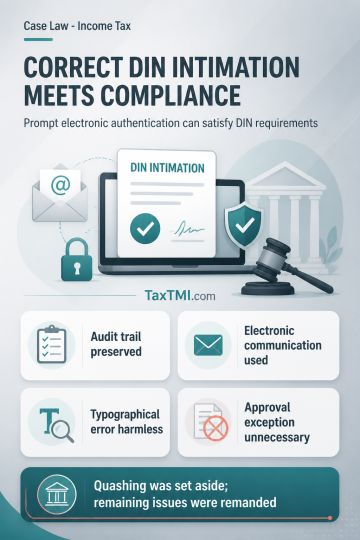
Document Identification Number compliance is satisfied when electronically communicated orders are promptly authenticated through a correctly identifi...
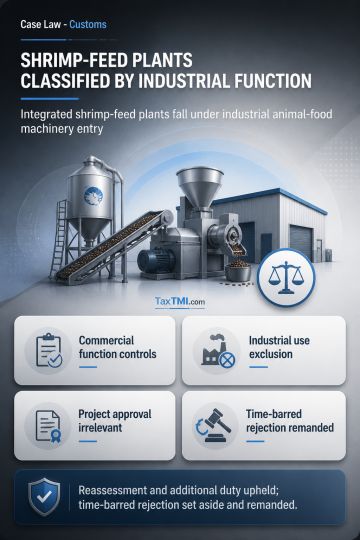
Industrial shrimp-feed machinery classification follows its commercial function, placing integrated production plants under the specific industrial fo...
Page of 4801
Press 'Enter' after typing page number.
1081 to 1100 of 96001 Results
❮
❯
❯❯
0 / 200
Expand Note
Add to Folder
No Folders have been created
+
Are you sure you want to delete "My most important" ?
The ITAT held that the order passed u/s 263 by the PCIT was in gross violation of the principles of natural justice. The Tribunal observed that the order disregarded the assessee's legal and factual submissions without any discussion or rebuttal, rendering the proceedings a mere formality. Furthermore, the Tribunal noted that the assessee had opted for the Vivad se Vishwas scheme, paid the due taxes, and provided judicial precedents supporting their claim for deduction u/s 10AA. The Assessing Officer, after considering the submissions, took a legally plausible view and did not disturb the deduction claim. The Tribunal also highlighted that several precedents have held that once an assessee opts for the Vivad se Vishwas scheme and pays taxes, the tax proceedings for that year cannot be re-agitated through Section 263 proceedings. Considering it was the ninth year of the deduction claim and the principle of consistency, the Tribunal ruled in favor of the assessee, setting aside the order passed u/s 263.
The ITAT held that the order passed u/s 263 by the PCIT was in gross violation of the principles of natural justice. The Tribunal observed that the order disregarded the assessee's legal and factual submissions without any discussion or rebuttal, rendering the proceedings a mere formality. Furthermore, the Tribunal noted that the assessee had opted for the Vivad se Vishwas scheme, paid the due taxes, and provided judicial precedents supporting their claim for deduction u/s 10AA. The Assessing Officer, after considering the submissions, took a legally plausible view and did not disturb the deduction claim. The Tribunal also highlighted that several precedents have held that once an assessee opts for the Vivad se Vishwas scheme and pays taxes, the tax proceedings for that year cannot be re-agitated through Section 263 proceedings. Considering it was the ninth year of the deduction claim and the principle of consistency, the Tribunal ruled in favor of the assessee, setting aside the order passed u/s 263.
Note: It is a system-generated summary and is for quick reference only.
 TaxTMI
 of 4801







 Join Channel


 TaxTMI