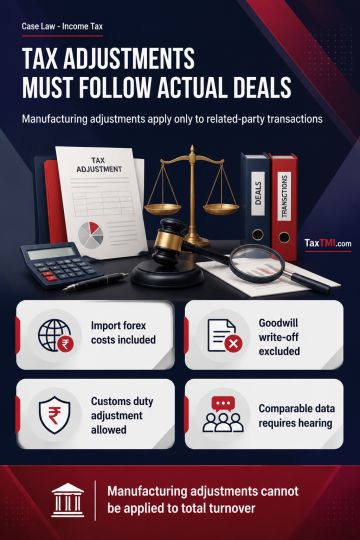
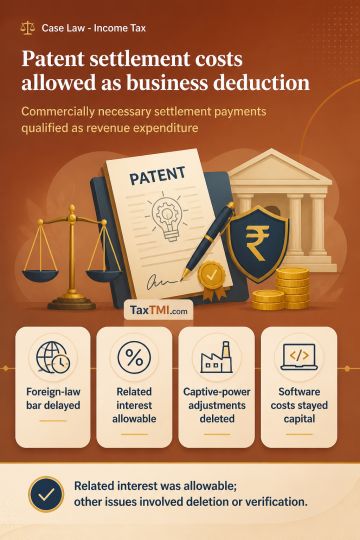
Patent-settlement expenditure treated as commercially expedient revenue outlay, with foreign-law restrictions inapplicable before the prospective amen...
International transaction benchmarking restricts transfer pricing adjustments to associated-enterprise dealings, while functional comparability govern...
Page of 4786
Press 'Enter' after typing page number.
161 to 180 of 95715 Results
❮
❯
❯❯
0 / 200
Expand Note
Add to Folder
No Folders have been created
+
Are you sure you want to delete "My most important" ?
The CESTAT held that insulin products manufactured using recombinant DNA technology would qualify as 'mono-component insulin' and are entitled to exemption under Notification No. 12/2012 Customs dated March 17, 2012, as they are lifesaving drugs. The classification of the imported insulin products is based on their content rather than source. The Tribunal accepted that 'mono-component' refers to the purity of insulin rather than its source, and there was no evidence that the disputed products had impurity levels higher than 1 PPM. The CESTAT upheld the classification of the imported insulin products under chapter heading 3004 31 10, making them eligible for the exemption as lifesaving drugs.
The CESTAT held that insulin products manufactured using recombinant DNA technology would qualify as 'mono-component insulin' and are entitled to exemption under Notification No. 12/2012 Customs dated March 17, 2012, as they are lifesaving drugs. The classification of the imported insulin products is based on their content rather than source. The Tribunal accepted that 'mono-component' refers to the purity of insulin rather than its source, and there was no evidence that the disputed products had impurity levels higher than 1 PPM. The CESTAT upheld the classification of the imported insulin products under chapter heading 3004 31 10, making them eligible for the exemption as lifesaving drugs.
Note: It is a system-generated summary and is for quick reference only.
 TaxTMI
 of 4786



 Join Channel


 TaxTMI