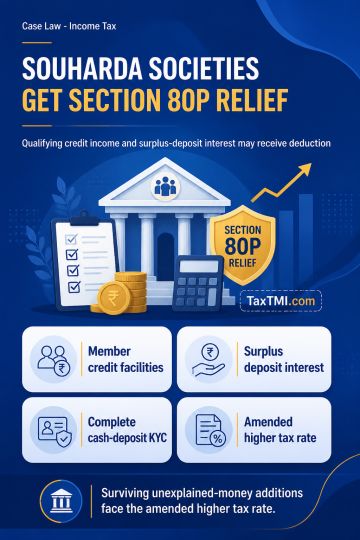
Section 80P deduction covers Souharda credit societies, including qualifying surplus-deposit interest, subject to member KYC verification for cash dep...
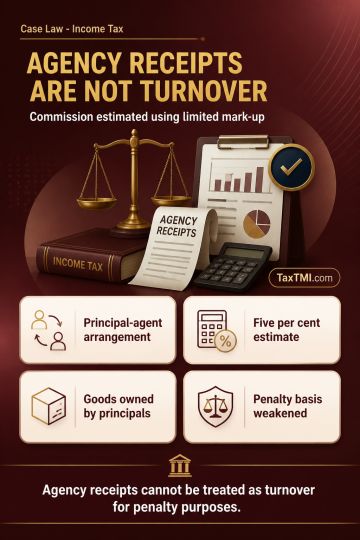
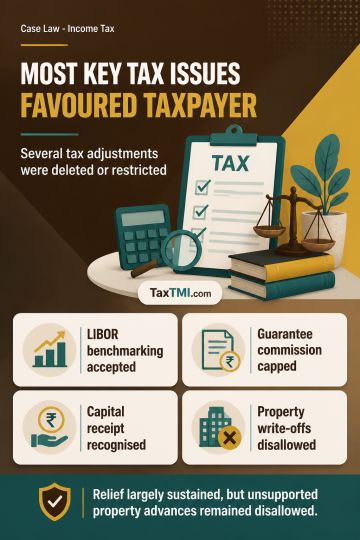
Transfer-pricing benchmarking and capital-receipt principles sustained taxpayer relief, while unsupported property-advance write-offs remained disallo...
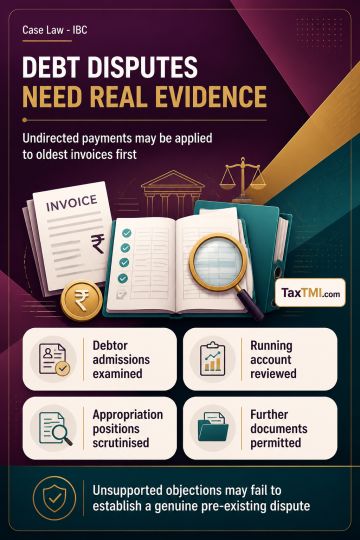
Pre-existing operational debt disputes require genuine evidence, while undirected running-account payments may be appropriated on a first-in-first-out...
Page of 4794
Press 'Enter' after typing page number.
821 to 840 of 95875 Results
❮
❯
❯❯
0 / 200
Expand Note
Add to Folder
No Folders have been created
+
Are you sure you want to delete "My most important" ?
The NCLAT dismissed the appeal filed by the corporate debtor against the order admitting the application u/s 7 of the Insolvency and Bankruptcy Code (IBC) filed by the Union Bank of India. The NCLAT held that there was a clear acknowledgment of outstanding dues by the corporate debtor prior to the Section 10A period. During the 10A period, additional facilities were extended, and the statements of account indicated an overdue amount of more than Rs. 1 crore as of March 31, 2021. The NCLAT referred to the Supreme Court's judgment in Laxmi Pat Surana vs. Union Bank of India, which held that the date of declaration of a loan account as a Non-Performing Asset (NPA) can be reckoned as the date of default for initiating action u/s 7 of the IBC. The NCLAT observed that while defaults during the 10A period cannot be the basis for proceedings u/s 7, the corporate debtor had committed continuous defaults even after the 10A period, exceeding the threshold amount. Therefore, the NCLAT upheld the Adjudicating Authority's order admitting the Section 7 application.
The NCLAT dismissed the appeal filed by the corporate debtor against the order admitting the application u/s 7 of the Insolvency and Bankruptcy Code (IBC) filed by the Union Bank of India. The NCLAT held that there was a clear acknowledgment of outstanding dues by the corporate debtor prior to the Section 10A period. During the 10A period, additional facilities were extended, and the statements of account indicated an overdue amount of more than Rs. 1 crore as of March 31, 2021. The NCLAT referred to the Supreme Court's judgment in Laxmi Pat Surana vs. Union Bank of India, which held that the date of declaration of a loan account as a Non-Performing Asset (NPA) can be reckoned as the date of default for initiating action u/s 7 of the IBC. The NCLAT observed that while defaults during the 10A period cannot be the basis for proceedings u/s 7, the corporate debtor had committed continuous defaults even after the 10A period, exceeding the threshold amount. Therefore, the NCLAT upheld the Adjudicating Authority's order admitting the Section 7 application.
Note: It is a system-generated summary and is for quick reference only.
 TaxTMI
 of 4794






 Join Channel


 TaxTMI